
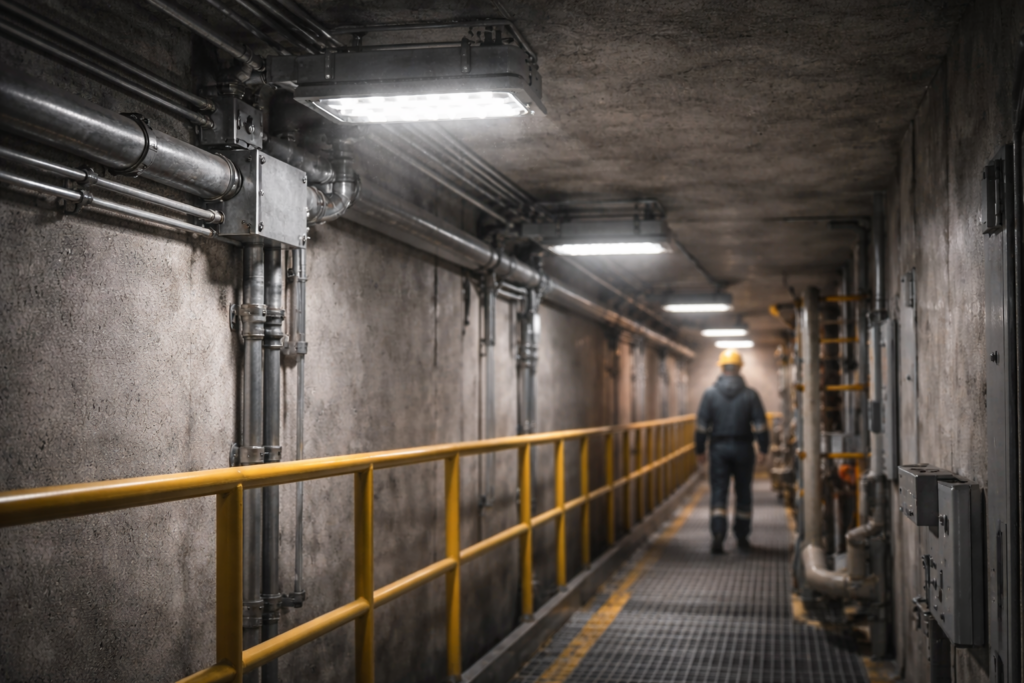
What if the safest lights in tough zones also became your quiet profit center? What shifts when every fixture pays you back monthly? Here’s how your setup turns into a lean, bright machine—starting with quick takeaways, then a battle-tested plan.
Key Takeaways
- See how hazardous zones waste power—and where you plug the leaks.
- Compare lighting types using simple numbers you can run in minutes.
- Use a step-by-step retrofit playbook for fast wins and long-term savings.
- Get a decision matrix to choose optics, certifications, and drivers with confidence.
- Leave with tools, prompts, and a mini example to brief your team today—then act.
The cost of “good enough” is eating your budget
Hazardous areas have zero margin for error, but the bill shows something else: energy drift, frequent re-lamping, and unplanned lifts for maintenance. The result? Higher kWh, higher risk, and hours of downtime that never show up on the P&L—until they do. High-pressure sodium still hums along. Fluorescent strips still flicker. Vibration does its thing. Heat does its thing. You keep paying for wasted watts and rushed callouts. And in Class I, Division 1/2 or Zones 1/2, every minute up a lift is a minute of risk.
Here’s the twist: safety and efficiency aren’t trade-offs. Tight thermal design, sealed optics, and smart drivers turn rugged fixtures into steady savers. LED explosion-proof lighting isn’t just about not igniting a gas cloud—it’s about cutting load, improving visibility, and stabilizing operations. When the beam is shaped right, you reduce over-lighting, glare, and shadow pockets that hide trip hazards. Better light equals better work quality, which equals fewer re-do’s.
So the question moves from “Is the fixture compliant?” to “Is the system compounding savings hour by hour?” Keep that lens, because the next step is understanding the simple mechanics behind the efficiency lift—and how to use them to your advantage.
How LEDs pull ahead (made simple)
Think of old tech as a leaky bucket. You pour energy in; heat and bad optics drip it out. LEDs patch the leaks in three ways:
- Lumen per watt: More light for the same energy.
- Directional optics: Light goes where tasks happen, not into voids.
- Driver intelligence: Stable current, dimming, and surge protection extend life.
Add semantic pieces you keep hearing: ATEX/IECEx, T-codes, IP/IK ratings, IES files, UGR, TM-21 L70, power factor, THD. They sound complex, but boil down to this: control heat, place photons precisely, and keep electronics healthy. That’s how you stretch life past 60,000 hours and crush relamp runs.
Imagine switching from a flood hose to a precision sprinkler. Same water source, wildly better coverage. LEDs use optics (Type I–V, narrow/medium/wide beams) to paint the work plane, not the ceiling. Pair that with high CRI and consistent CCT, and tasks get faster because eyes strain less.
You’re now ready to map the energy math onto your facility, which sets up a clear path to decisions, budgets, and rollout sequencing.
Advanced choices that stack savings
This is where efficiency becomes a system, not a part number. Use these frameworks to pick gear and plan the rollout.
Decision Matrix (pick what actually matters)
- Environment: Gas group, dust type, ambient temp, vibration.
- Certification: ATEX/IECEx or NEC Class/Division. Verify T-code margin vs. max case temp.
- Optics: Narrow aisles? Use linear, flexible LED strips or IES Type I/II.
- Thermals: Finned housing, marine-grade coating, L70 ≥ 60,000h @ real ambient.
- Controls: Occupancy + daylight sensors; group dimming by zone.
- Mounting: Pendant vs. wall vs. stanchion; keep tilt/aim repeatable.
- Serviceability: Tool-less access where allowed; quick-connects; spare driver strategy.
Mini Framework: “Light Where Work Lives”
Map tasks → choose optics → set mounting height → aim to task plane → cap light loss with clean lenses + correct CCT.
Step-by-Step Checklist (pin to your clipboard)
- Audit hazardous zones by class/division or zone/group.
- Log current wattage, fixture count, hours/year, failures/year, lift cost/incident.
- Capture illuminance at task level (lux/footcandle) and glare complaints.
- Align certifications (ATEX/IECEx or NEC) and T-code with ambient worst-case.
- Select optics per area geometry; request IES files and run quick calcs.
- Specify drivers (surge, PF, THD) and dimming method.
- Pilot one high-pain area for 30 days; track kWh and maintenance calls.
- Roll out in waves: highest kWh/fixture × hours first; bundle lift visits.
- Train crews on cleaning intervals and sensor tuning.
- Review quarterly: kWh, lux, downtime, accident reports; adjust dim levels.
Implementation Table
| Step | What to Do | Tool | Time | Output |
|---|---|---|---|---|
| 1 | Zone & task audit | Floor plan + lux meter | 1–2 days | Map with target lux |
| 2 | Baseline energy & downtime | Utility data + CMMS | 2–4 hrs | kWh + callout rate |
| 3 | Optics & layout | IES viewer / calc | 4–8 hrs | Fixture count & aiming |
| 4 | Spec drivers & surge | Datasheets check | 1–2 hrs | Approved BOM |
| 5 | Pilot install | Lift + crew | 1 day | Before/after metrics |
| 6 | Controls tuning | 0–10V/DALI setup | 1–2 hrs | Verified dim profiles |
| 7 | Wave rollout | Project plan | 2–6 weeks | Lower kWh + fewer calls |
You’ve got the “why” and the “what.” Now convert it into action with exact steps, timelines, and a quick worked example.
Action: Do this in the next 30 days
Week 1: Measure and model
- Walk the hazardous areas with a lux meter app and a simple grid.
- Pull last 12 months of utility and CMMS records.
- Request IES files for two shortlisted fixtures; run a quick layout to hit target lux with fewer heads.
- Shortlist optics by area: aisles (narrow), open pads (wide), process rooms (medium with glare control).
Week 2: Pilot
- Replace 10% of fixtures in one high-hour zone.
- Set baseline dim level at 80% and enable occupancy in low-traffic windows.
- Log kWh via submeter or utility interval data.
- Interview operators: glare? shadows? color shift?
Week 3–4: Rollout plan
- Prioritize zones by (kWh/fixture × hours) and lift access cost.
- Bundle mounting hardware and drivers to reduce SKUs.
- Train the maintenance team on cleaning intervals and driver swap.
- Approve spare strategy: 2–5% drivers and lenses on hand.
Worked Example (simulation)
- Old tech: 400 W HPS, 200 fixtures, 6,000 hrs/year. Load = 80 kW.
- New tech: 150 W LED equivalents, same count. Load = 30 kW.
- Demand cut: 50 kW. Energy saved: 50 kW × 6,000 hrs = 300,000 kWh/year.
- At $0.12/kWh → $36,000/year in energy.
- Maintenance: if relamping cost is $120/fixture annually (lamp + lift + labor) and LEDs push that to near-zero for 5+ years, that’s $24,000/year avoided.
- Total annual impact ≈ $60,000 before incentives.
Keep these numbers handy, because the next section shows where edge cases can bend the plan—and how to steer through them.
Nuances & Perspectives
Not all “LED” is created equal. Thermal limits matter in hot process areas; optics that win in open yards can produce glare indoors; drivers without proper surge protection die young in storm-prone regions. Controls can backfire too—over-aggressive occupancy dimming in high-risk zones can drop light levels below safe thresholds during surprise interventions.
If ambient temperature routinely spikes, then spec a lower T-code headroom and de-rate drive current. If corrosive atmospheres are present, then treat coating and gasket materials as first-class requirements, not afterthoughts. If forklift aisles create strobe risk, then use higher refresh drivers and avoid PWM profiles that interact with wheel speed.
Budget tension? If capital is tight, then phase by hours×load and pursue rebates; if downtime is the constraint, then use weekend wave installs and prefabricated mounting kits to cut time aloft. Sensor confusion in classified spaces? If occupancy is unreliable, then bias toward scheduled dimming with manual override near control points.
.
Conclusion
Efficiency in hazardous locations isn’t a nice-to-have; it’s protection for people, budgets, and uptime. The opening question asked if the safest lights could also become a profit center. The answer lands in the math: lower wattage, longer life, better optics, and fewer lifts. When light hits only where work lives, shadows disappear, eyes relax, and tasks move faster—with less risk riding on each shift.
You’ve now got a clear path: audit zones, model with IES files, run a pilot, and scale by the highest kWh×hour areas. Pair solid thermal design with smart drivers and sensible controls; stock a lean set of spares; review quarterly. Do that, and the lighting system stops nagging for attention and starts quietly paying the bills. Begin with one zone this month, show the savings, and let that proof fuel the rest of the upgrade.