
Did you know that a light fixture that’s too hot can blow up your entire facility? Scary, right? The truth is, when it comes to explosion-proof lighting, what you can’t see CAN hurt you. Most people focus on enclosure design or certification marks, completely missing the critical factor that actually prevents explosions – temperature control. Your facility’s safety depends on understanding this hidden danger, and today, I’m going to show you exactly why surface temperature matters and how to manage it properly in your hazardous location lighting.
Key Takeaways
- Surface temperature directly determines whether your lighting will trigger an explosion
- T-ratings are your safety guideline – choose them based on your specific hazardous materials
- Proper heat management extends both safety margins and your lighting investment
- Simple maintenance techniques can prevent dangerous temperature-related failures
- Advanced monitoring options provide early warning of potential temperature problems
Understanding Why Surface Temperature Creates Explosion Risks
Ever wondered why some environments need special lighting? It’s all about the invisible danger zone where heat meets flammable materials.
In hazardous locations, you’re surrounded by gases, vapors, or dust that can ignite at specific temperatures. Each substance has its own “autoignition temperature” – the point where it bursts into flames without a spark. Your lighting fixtures generate heat during operation, creating hot surfaces that could reach these dangerous temperatures.
Take propane, for instance. It ignites at 470°C (878°F). If your light fixture runs hotter than this, you’ve essentially created a time bomb in your facility.
Here’s a quick reference table of common substances and their ignition points:
| Substance | Autoignition Temperature | Required T-Rating |
| Hydrogen | 520°C (968°F) | T1 |
| Propane | 470°C (878°F) | T1 |
| Ethanol | 365°C (689°F) | T2 |
| Gasoline | 280°C (536°F) | T2 |
| Ethyl Ether | 160°C (320°F) | T4 |
| Carbon Disulfide | 90°C (194°F) | T6 |
Real-world consequence? In 2019, a petroleum processing facility experienced a devastating explosion when a lighting fixture with an inadequate T-rating overheated near a propane leak. The investigation revealed the surface temperature exceeded the gas’s ignition point by just 15°C – a small difference with catastrophic results.
Decoding T-Ratings: Your Temperature Safety Code
T-ratings might seem like confusing technical jargon, but they’re actually your simplest guide to temperature safety. Think of them as the “speed limit signs” for your lighting – exceed them at your peril!
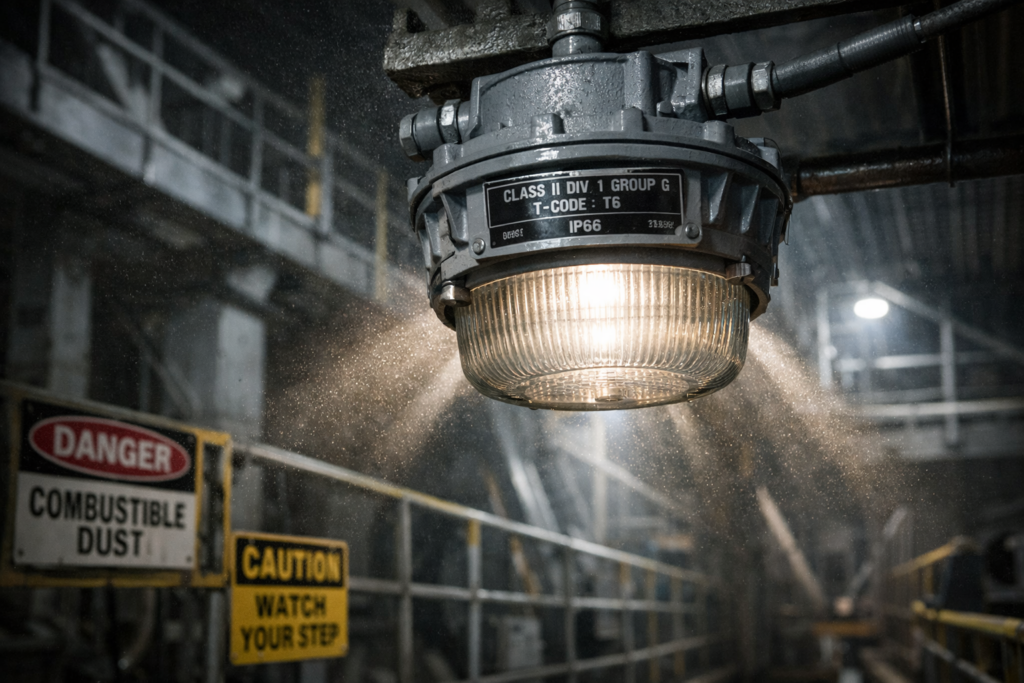
Each T-rating corresponds to a maximum surface temperature your fixture can reach under any condition:
- T1: 450°C (842°F)
- T2: 300°C (572°F)
- T3: 200°C (392°F)
- T4: 135°C (275°F)
- T5: 100°C (212°F)
- T6: 85°C (185°F)
Here’s the trick most people miss: always choose a T-rating LOWER than your hazardous material’s ignition temperature. This gives you a crucial safety buffer.
For example, if you’re working with ethanol (ignition temp 365°C), don’t pick a T1 fixture (450°C max) – that’s dangerously close! Instead, choose T2 (300°C max) for a safer 65°C buffer.
But wait – there’s more complexity! Different countries use variations of this system. While North America uses the T-rating system above, some European standards use temperature classes like “T3” but with slightly different values. Always check your local regulations!
Heat Management Techniques You Won’t Find in Basic Guides
Want to know what separates average safety from exceptional safety? It’s all in how you manage heat. Beyond basic compliance, these advanced techniques will significantly reduce your risk:
- Strategic material selection: Aluminum fixtures conduct heat 10x better than stainless steel. For extremely hot environments, choose fixtures with aluminum heat sinks and stainless steel enclosures for the best of both worlds.
- Thermal bridging optimization: Create dedicated heat pathways from internal components to external surfaces. This technique can reduce hotspot temperatures by up to 40%!
- Surface treatment enhancements: High-emissivity coatings on your fixtures can improve radiant heat dissipation by 15-25%. Look for black anodized or specially treated surfaces.
- Micro-fin design: The newest explosion-proof fixtures use microscopic fins that increase surface area without creating dust-collecting crevices. These can improve cooling by 30% while maintaining cleanability.
- Temperature derating practices: For every 10°C above rated ambient temperature, reduce your fixture’s power by 15%. This simple practice creates additional safety margins in fluctuating environments.
Implementation example: A chemical processing plant in Texas reduced fixture surface temperatures by 37°C by switching to micro-finned LED fixtures with high-emissivity coatings, despite ambient temperatures regularly exceeding 40°C.
The LED Advantage: Cooler Operation Equals Better Safety
Let’s talk about a game-changer for your hazardous location lighting: LED technology dramatically improves your safety margins through superior temperature management.
Here’s why LEDs give you an edge:
- They convert more electricity to light (less wasted as heat)
- Heat generation is distributed rather than concentrated
- No hot filaments or arc tubes that create dangerous hotspots
- Lower operating temperatures extend fixture lifespan
In real terms, this means an LED fixture might operate with a surface temperature of 65°C while an equivalent HID fixture could reach 150°C or higher. That’s a massive safety improvement!
But not all LED fixtures are created equal. Look for these advanced design features:
- Metal-core PCBs that conduct heat away from LED chips
- Direct thermal coupling between LED boards and housing
- Temperature sensors that trigger protective dimming
- Driver components positioned away from LED arrays
Pro tip: When selecting LED fixtures, ask for the temperature rise test data, not just the T-rating. A fixture rated T4 (135°C max) that only reaches 90°C in testing gives you much more safety headroom than one that barely meets the T4 limit.
Beyond Basics: Compliance Requirements You Can’t Ignore
Staying compliant with temperature regulations isn’t just about checking a box – it’s about knowing the specific requirements for your facility. Here’s what’s often missed:
Different regulatory frameworks have different testing requirements:
- IECEx/ATEX: Tests for maximum surface temperature under “normal” and “fault” conditions
- NEC/CEC: Tests for maximum temperature under specific ambient conditions plus safety factors
- GB (China): Includes additional thermal cycling and thermal endurance tests
Your documentation must include:
- Temperature code or T-rating clearly marked on the fixture
- Maximum ambient temperature rating
- Special conditions affecting temperature performance
- Specific installation parameters that affect temperature
Did you know? The penalties for non-compliance with temperature standards can reach $70,000 per violation in the US under OSHA regulations, not counting potential criminal liability if an incident occurs.
Advanced compliance tip: Create a temperature compliance matrix for your facility mapping specific hazardous materials to required T-ratings by zone. This helps prevent the common mistake of using the wrong fixture in the wrong area.
Installation Secrets That Keep Temperatures Down
The way you install your explosion-proof lighting can make or break your temperature safety. Follow these expert installation practices:
- Spacing magic: Allow minimum clearance of 12 inches between fixtures and any potential heat sources. For every inch less than recommended clearance, surface temperatures can increase by 3-5°C.
- Wire sizing strategy: Always upsize power conductors one gauge from minimum requirements. This reduces resistance heating by approximately 20%.
- Connection technique: Apply thermal compound to threaded connections between housings and conduit. This improves heat transfer by up to 35%.
- Environmental positioning: Mount fixtures where natural air movement helps cooling. Avoid dead air spaces where temperatures can be 10-15°C higher than surrounding areas.
- Thermal imaging verification: After installation, conduct thermal imaging under full load to identify unexpected hot spots. This catches problems before they become hazards.
Real-world application: An oil refinery reduced fixture surface temperatures by 22°C simply by implementing these installation techniques, bringing borderline T3 fixtures well within safe operating parameters.
Smart Monitoring: Catching Temperature Problems Before They Catch Fire
Most facilities rely on scheduled inspections to catch temperature issues, but advanced monitoring gives you continuous protection:
- Integrated temperature sensors: Newer explosion-proof fixtures include built-in sensors that can:
- Alert maintenance when temperatures exceed thresholds
- Automatically reduce power to prevent overheating
- Log temperature data for trend analysis
- Wireless monitoring systems: Deploy wireless temperature sensors on critical fixtures to:
- Create real-time temperature maps of your facility
- Set graduated warning levels before critical temperatures
- Integrate with existing building management systems
- Thermal signature analysis: Regular thermal imaging with pattern recognition can:
- Detect gradual temperature increases that indicate problems
- Identify anomalies compared to similar fixtures
- Predict failures before they occur
Implementation case: A natural gas processing facility installed wireless temperature monitoring on 127 explosion-proof fixtures. Within three months, the system identified seven fixtures with abnormal temperature rises, allowing replacement before they reached dangerous levels.
Warning signs you should never ignore:
- Discoloration of fixture housings
- Unusual warmth detected during inspection
- Flickering or dimming of light output
- Reduced fixture lifespan compared to specifications
What to watch for: Regulatory standards are evolving to incorporate these new technologies. Expect updates to IECEx and NEC standards within the next 18-24 months that will recognize these advanced cooling methods.
Conclusion
Throughout this guide, we’ve uncovered why surface temperature is the critical factor in explosion-proof lighting safety. You’ve learned that selecting the right T-rating for your specific hazardous materials creates essential safety margins. You’ve discovered advanced heat management techniques that go beyond basic compliance to dramatically improve safety. And you’ve seen how proper installation, maintenance, and monitoring create layers of protection against temperature-related hazards.
Remember, when it comes to explosion-proof lighting, what you can’t see – heat – presents the greatest danger. By implementing the strategies we’ve discussed, you’re not just checking compliance boxes; you’re actively protecting lives and assets. I encourage you to evaluate your current lighting systems against these advanced practices and consider upgrading where necessary.