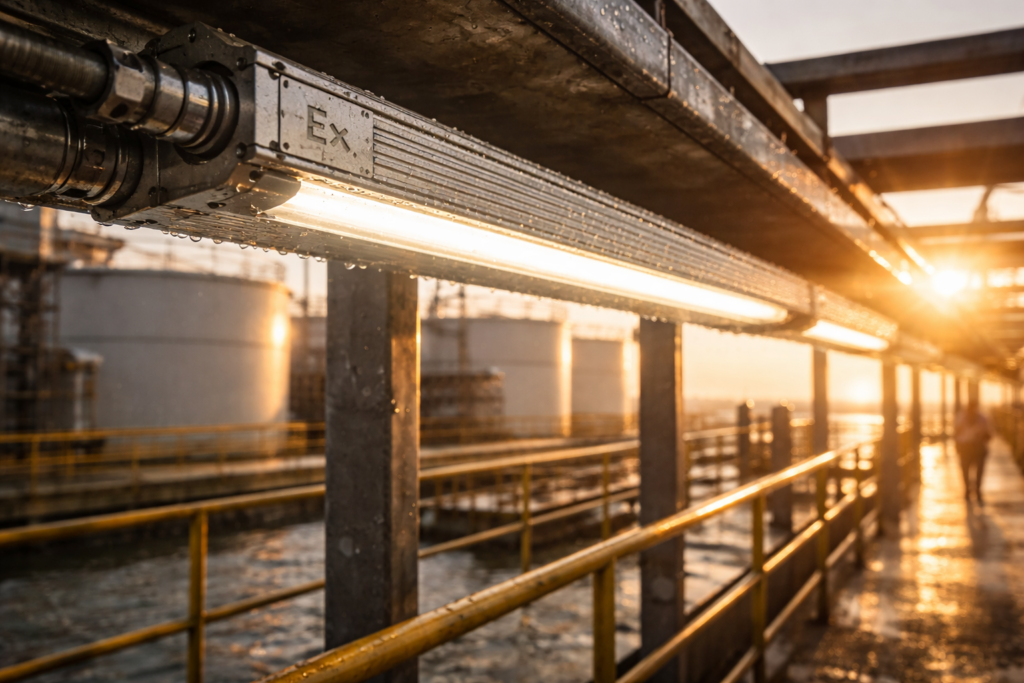
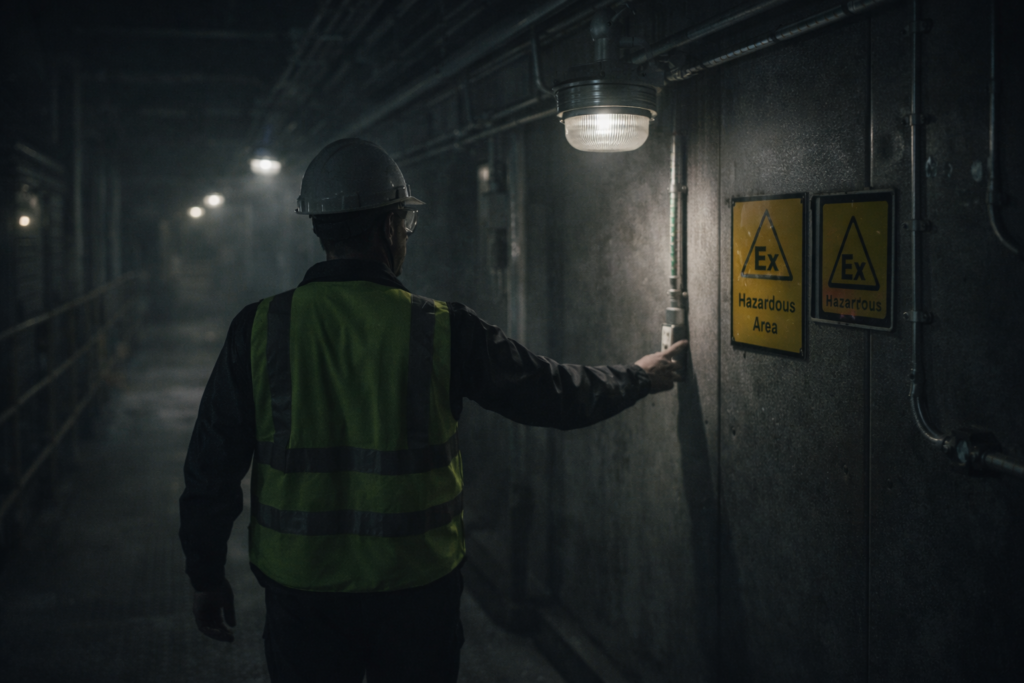
Hazardous location lighting requires rigorous testing and certification to prevent explosions, fires, and regulatory violations. This guide reveals advanced compliance strategies, testing methodologies, and certification processes that go beyond basic requirements—helping you navigate complex regulations while ensuring worker safety and avoiding costly penalties.
Understanding Why Testing and Certification Matter
You’re dealing with explosive atmospheres every day. Whether you manage an oil refinery, chemical plant, or grain processing facility, your lighting choices could literally mean the difference between safe operations and catastrophic failure.
The importance of testing and certification for hazardous location lighting isn’t just about checking regulatory boxes. It’s about protecting lives, preserving assets, and maintaining operational continuity in environments where a single spark can trigger devastating consequences.
Your lighting systems must withstand extreme conditions while preventing ignition sources. That’s where comprehensive testing and certification become your safety net.
Key Takeaways
- Certification Standards: ATEX, IECEx, and UL certifications each serve different global markets with specific testing requirements
- Testing Methodologies: Impact resistance, temperature cycling, and ingress protection testing ensure real-world reliability
- Advanced Compliance: Multi-standard certification strategies reduce global deployment costs and regulatory complexity
- Implementation Framework: Systematic approach to specification, procurement, and installation ensures long-term compliance
Understanding Hazardous Location Classification Systems
Zone vs. Division Classification Methods
Your hazardous location classification determines everything about your lighting requirements. The Division system (North American) and Zone system (International) create different testing and certification pathways that directly impact your equipment selection.
Division Classification:
- Division 1: Hazardous substances present during normal operations
- Division 2: Hazardous substances present only during abnormal conditions
Zone Classification:
- Zone 0/20: Continuous presence (>1000 hours/year)
- Zone 1/21: Occasional presence (10-1000 hours/year)
- Zone 2/22: Unlikely presence (<10 hours/year)
Understanding these distinctions helps you specify appropriate protection methods and certification requirements. Your lighting must match the specific hazard classification, not just meet general “hazardous location” standards.
Advanced facilities often deal with multiple classification zones within the same area. This complexity requires sophisticated lighting design that addresses varying protection levels while maintaining operational efficiency.
The transition zones between different classifications present unique challenges. Your lighting systems must accommodate these boundary conditions without compromising safety or creating maintenance complications that could affect long-term reliability.
Gas Groups and Temperature Classifications
Gas groups categorize hazardous substances by their ignition characteristics, directly influencing your lighting’s construction and testing requirements. Group A (acetylene) demands the most stringent protection, while Group D (methane) allows more flexible designs.
| Gas Group | Typical Substances | Key Testing Requirements |
|---|---|---|
| Group A | Acetylene | Minimal gap, highest protection |
| Group B | Hydrogen, Butadiene | Enhanced sealing, special construction |
| Group C | Ethylene, Ether | Standard protection methods |
| Group D | Methane, Gasoline | Most common, flexible options |
Temperature classifications (T1-T6) establish maximum surface temperatures your lighting can reach. T6 (85°C) represents the most restrictive category, while T1 (450°C) allows higher operating temperatures.
Your lighting selection must consider both steady-state and transient temperature conditions. Starting surges, ambient temperature variations, and aging effects all influence maximum surface temperatures that testing must validate.
Advanced temperature management involves thermal modeling that predicts performance under various operating conditions. This proactive approach prevents temperature-related failures that could compromise safety or violate certification requirements.
Now that you understand classification fundamentals, let’s examine the specific testing methodologies that validate your lighting’s safety performance.
Comprehensive Testing Methodologies for Hazardous Location Lighting
Explosion Protection Testing Protocols
Explosion protection testing pushes your lighting beyond normal operational limits to validate safety margins under extreme conditions. These tests simulate worst-case scenarios that standard equipment never encounters.
Flameproof Testing (Ex d): Your lighting enclosure must contain internal explosions without external flame transmission. Testing involves introducing explosive gas mixtures inside the enclosure, triggering ignition, and measuring flame propagation through joints and openings.
Gap testing determines minimum clearances that prevent flame transmission. Your enclosure joints must maintain specific gap dimensions even under thermal expansion, mechanical stress, and aging effects. Advanced testing includes accelerated aging protocols that simulate years of service conditions.
Increased Safety Testing (Ex e): This protection method prevents sparks and excessive temperatures through enhanced construction. Testing validates electrical clearances, creepage distances, and temperature limitations under fault conditions.
Thermal cycling tests subject your lighting to extreme temperature variations that simulate real-world conditions. Your components must maintain electrical integrity and mechanical stability throughout these cycles without developing safety-compromising failures.
Intrinsic Safety Testing (Ex i): The most sophisticated protection method limits electrical energy to levels incapable of causing ignition. Testing involves fault simulation that introduces maximum credible energy into circuits while monitoring ignition capability.
Your intrinsically safe lighting must maintain safety even under multiple simultaneous faults. Advanced testing protocols evaluate energy storage, inductive effects, and capacitive coupling that could compromise intrinsic safety principles.
Environmental Stress Testing Requirements
Environmental testing validates your lighting’s performance under harsh conditions that hazardous locations typically present. These tests go far beyond standard industrial equipment requirements.
Ingress Protection (IP) Testing: Your lighting must prevent harmful ingress of dust, water, and corrosive substances. IP65 rating requires complete dust protection and water jet resistance from any direction.
Advanced IP testing includes pressure differential testing that simulates breathing effects from temperature cycling. Your sealing systems must maintain integrity even when internal pressures change due to thermal effects.
Vibration and Shock Testing: Industrial environments subject lighting to mechanical stresses that can loosen connections, crack seals, or damage components. Vibration testing uses frequency sweeps that identify resonant frequencies where failures might occur.
Shock testing simulates impacts from dropped tools, equipment collisions, or structural movements. Your lighting must maintain electrical integrity and explosion protection even after experiencing specified shock levels.
Chemical Compatibility Testing: Hazardous locations often contain aggressive chemicals that attack standard materials. Chemical compatibility testing exposes your lighting materials to representative substances over extended periods.
Advanced chemical testing includes synergistic effects where multiple chemicals create more aggressive conditions than individual exposures. Your lighting materials must resist degradation that could compromise safety or performance.
The complexity of environmental testing reveals why proper certification becomes essential for long-term reliability and safety assurance.
Global Certification Standards and Compliance Strategies
ATEX Certification Requirements and Process
ATEX certification governs European markets with comprehensive requirements that address equipment design, manufacturing quality, and conformity assessment. Your lighting must demonstrate compliance through rigorous documentation and testing protocols.
Essential Health and Safety Requirements (EHSRs): ATEX demands systematic risk analysis that identifies potential ignition sources and validates protective measures. Your lighting design must incorporate risk reduction principles that eliminate or control ignition hazards.
The technical construction file documents your design decisions, material selections, and safety analyses. This comprehensive documentation package enables notified bodies to evaluate compliance and issue certificates.
Conformity Assessment Procedures: Different conformity assessment modules apply based on your lighting’s protection concept and risk level. Module B (EC type examination) plus Module D (production quality assurance) represents the most common certification path.
Quality system requirements ensure your manufacturing processes maintain certified product characteristics. Regular surveillance audits verify ongoing compliance with approved procedures and specifications.
CE Marking and Declaration of Conformity: Your ATEX-certified lighting requires CE marking that demonstrates regulatory compliance. The Declaration of Conformity formally declares compliance with applicable directives and harmonized standards.
Advanced ATEX strategies involve modular certification approaches that reduce time-to-market for product variants. Generic certificates covering multiple configurations streamline certification processes while maintaining safety integrity.
IECEx and UL Certification Pathways
IECEx provides international certification based on IEC standards, enabling global market access through mutual recognition agreements. This system reduces certification complexity for multinational deployments.
IECEx Certificate of Conformity (CoC): The CoC demonstrates compliance with IEC 60079 series standards through testing at accredited laboratories. Your lighting manufacturer must maintain quality assurance programs that ensure ongoing compliance.
Certificate holders can leverage mutual recognition to access multiple markets without redundant testing. This approach significantly reduces certification costs and time-to-market for global products.
UL Certification for North American Markets: UL certification addresses unique North American requirements including NEC Article 500 and Canadian Electrical Code requirements. Testing protocols align with ANSI/UL standards while addressing specific regulatory nuances.
Class I, Division 1/2 certification requires comprehensive evaluation of explosion protection methods, temperature limitations, and electrical safety. Your lighting must demonstrate compliance through rigorous testing protocols.
Multi-Standard Certification Strategies: Advanced manufacturers pursue simultaneous certification to multiple standards, creating products that access global markets. This approach requires sophisticated design strategies that address varying technical requirements.
| Standard | Geographic Scope | Key Requirements | Typical Timeline |
|---|---|---|---|
| ATEX | European Union | EHSR compliance, CE marking | 12-18 months |
| IECEx | International | IEC 60079 series, QAR | 8-12 months |
| UL | North America | ANSI/UL standards, NEC compliance | 6-10 months |
The strategic approach to certification planning can dramatically impact your project timelines and costs, making proper planning essential.
Advanced Implementation Strategies for Compliant Lighting Systems

Specification Development and Vendor Qualification
Developing comprehensive specifications requires deep understanding of your specific hazardous environment characteristics and operational requirements. Your specifications must address technical requirements while enabling competitive procurement processes.
Environmental Analysis Framework: Document your hazardous substances, classification zones, and environmental conditions systematically. This analysis forms the foundation for all technical requirements and certification needs.
Ambient temperature ranges, humidity levels, and chemical exposures directly influence material selections and protection methods. Your specifications must account for worst-case conditions that equipment might encounter during its service life.
Performance Requirements Matrix: Create detailed performance matrices that address operational requirements, maintenance needs, and lifecycle considerations. This systematic approach ensures specifications capture all critical requirements without unnecessary over-specification.
| Parameter | Requirement | Test Standard | Acceptance Criteria |
|---|---|---|---|
| Luminous Efficacy | >100 lm/W | IES LM-79 | Minimum maintained output |
| Operating Temperature | -40°C to +60°C | IEC 60079-0 | No safety degradation |
| Impact Resistance | IK08 minimum | IEC 62262 | No protective degradation |
| Ingress Protection | IP65 minimum | IEC 60529 | No harmful ingress |
Vendor Qualification Process: Establish systematic vendor qualification that evaluates technical capability, quality systems, and certification compliance. Your qualification process should verify actual testing and certification rather than relying on claims.
Advanced qualification includes facility audits that assess manufacturing capabilities, quality control systems, and technical support resources. These assessments predict long-term vendor performance and support capabilities.
Installation and Commissioning Best Practices
Proper installation and commissioning ensure your certified lighting maintains safety performance throughout its operational life. Installation errors can compromise certification compliance and create safety vulnerabilities.
Pre-Installation Verification: Verify delivered equipment matches approved certifications and specifications before installation begins. Documentation review should confirm certificate validity, marking compliance, and configuration accuracy.
Environmental condition verification ensures installation locations match design assumptions. Temperature, chemical exposure, and mechanical stress conditions must align with certified performance parameters.
Installation Quality Control: Systematic installation procedures ensure workmanship meets certification requirements. Cable entry methods, sealing techniques, and mounting procedures must maintain explosion protection integrity.
Advanced installation includes torque verification, seal testing, and electrical verification that validates proper installation. These quality control measures prevent installation-related failures that could compromise safety.
Commissioning and Performance Validation: Comprehensive commissioning includes functional testing, performance verification, and documentation completion. Your commissioning process should validate that installed systems meet design requirements and certification compliance.
Performance testing includes light output verification, electrical parameter measurement, and safety system functionality confirmation. This systematic approach ensures your lighting systems deliver intended performance while maintaining safety compliance.
The sophisticated implementation approach positions you for long-term success while minimizing compliance risks and operational disruptions.
Conclusion: Mastering Hazardous Location Lighting Compliance
The importance of testing and certification for hazardous location lighting extends far beyond regulatory checkbox exercises. Your commitment to comprehensive testing and certification creates a foundation for operational safety, regulatory compliance, and long-term asset protection.
Your next step involves evaluating your current lighting systems against these advanced compliance strategies. Begin with a comprehensive audit of your existing certifications, maintenance procedures, and long-term compliance plans.