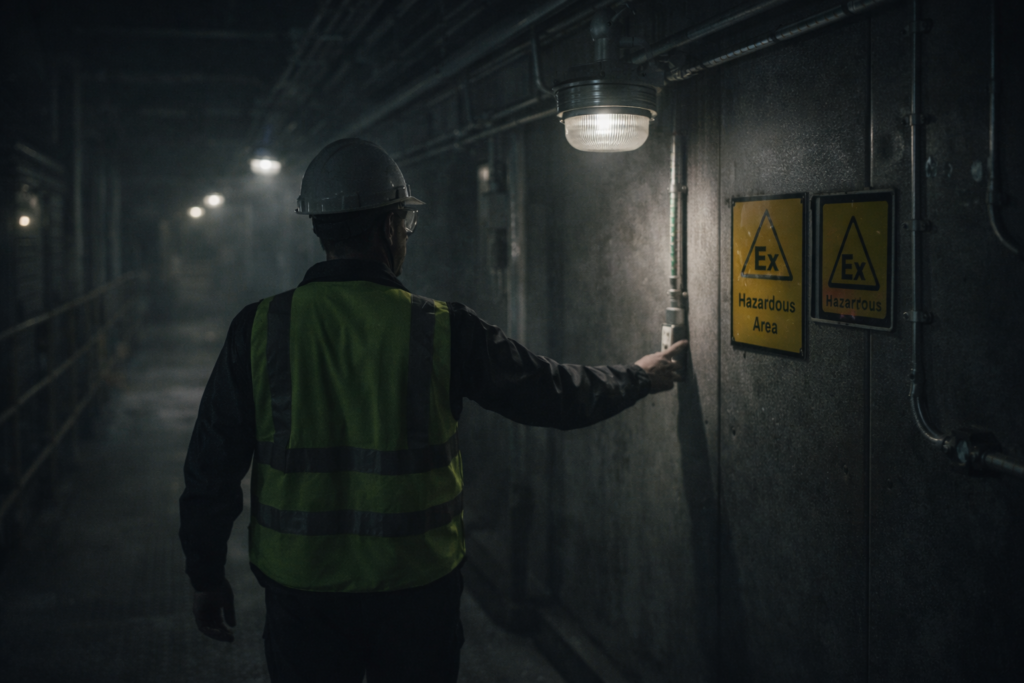

Ever stared at an IECEx or ATEX certificate and felt like you’re reading hieroglyphics in a foreign language?
Reading IECEx and ATEX certificates for LED lighting requires understanding specific codes, protection levels, and temperature classifications. This guide breaks down every certificate element so you can verify compliance, select appropriate products, and avoid costly installation mistakes in hazardous environments.
Key Takeaways
• Master certificate anatomy – Decode marking codes, protection types, and temperature classes instantly
• Verify product suitability – Match certificate specifications to your specific hazardous area requirements
• Spot red flags – Identify incomplete certifications and potential compliance gaps before installation
• Navigate regional differences – Understand when IECEx versus ATEX applies to your project location
Why Certificate Reading Skills Matter More Than Ever
Hazardous area lighting mistakes don’t just cost money – they can cost lives. When you’re specifying LED lighting for petrochemical facilities, mining operations, or pharmaceutical manufacturing, that certificate isn’t just paperwork. It’s your safety net.
The problem? Most professionals can’t properly read these certificates. They glance at the basic markings, assume everything checks out, and move forward. Then reality hits during commissioning when inspectors flag non-compliant installations, forcing expensive retrofits and project delays.
Certificate misreading creates three critical risks: selecting products unsuitable for your specific hazardous classification, missing temperature limitations that could cause equipment failure, and overlooking installation restrictions that void warranties and insurance coverage.
Your ability to read an IECEx or ATEX certificate for LED lighting products directly impacts project success, safety compliance, and your professional credibility. Each certificate contains dozens of technical details that determine whether your lighting solution will perform safely in explosive atmospheres.
Understanding these certificates transforms you from someone who hopes the product works to someone who knows it will work, backed by verified technical documentation and regulatory approval.
Certificate Fundamentals Made Simple
Think of hazardous area certificates like a passport for LED lighting products. Just as passports contain specific information allowing travel to certain countries, certificates contain technical specifications allowing operation in specific hazardous zones.
Two primary certification systems dominate the global market: IECEx (International Electrotechnical Commission Explosion Protection) provides worldwide recognition, while ATEX (Atmosphere Explosive) serves European Union markets. Both follow similar principles but have distinct formatting and requirements.
Certificate core components include equipment identification, protection concept verification, and environmental operating parameters. The equipment identification section specifies manufacturer details, model numbers, and unique certificate numbers. Protection concept verification confirms the explosion protection method – whether intrinsically safe, flameproof, increased safety, or other protection types.
Environmental parameters define where and how the equipment operates safely. These include gas group classifications (indicating which explosive gases the equipment can handle), temperature classifications (maximum surface temperatures), and ingress protection ratings for dust and moisture resistance.
Certificate validity periods, testing laboratory credentials, and regional scope complete the documentation picture. Understanding these semantic relationships – how gas groups relate to temperature classes, how protection types connect to installation requirements – enables confident product selection and compliance verification.
Next, you’ll discover the systematic approach to dissecting these certificates section by section.
Advanced Certificate Analysis Framework
Mastering certificate analysis requires methodical evaluation using proven frameworks. Professional engineers use structured approaches that eliminate guesswork and ensure comprehensive compliance verification.
Certificate Analysis Matrix
| Analysis Phase | Key Elements | Verification Method | Risk Level |
|---|---|---|---|
| Header Review | Certificate number, validity, laboratory | Cross-reference official database | Critical |
| Product Identification | Model numbers, serial ranges, variants | Match exact specifications | Critical |
| Protection Analysis | Ex marking, protection type, gas group | Decode technical standards | High |
| Environmental Limits | Temperature class, IP rating, ambient conditions | Calculate safety margins | High |
| Installation Requirements | Cable entries, mounting restrictions, accessories | Review installation drawings | Medium |
Systematic Certificate Reading Protocol
Step 1: Certificate Authentication Verify certificate authenticity through official certification body databases. Check certificate number, issue date, and validity period. Confirm the testing laboratory holds proper accreditation for the protection type being certified.
Step 2: Product Specification Matching
Cross-reference certificate product details against manufacturer specifications. Verify model numbers, serial number ranges, and any product variants covered under the certificate. Document any discrepancies for manufacturer clarification.
Step 3: Hazardous Area Compatibility Analysis Decode Ex markings to determine protection concept, gas group, and temperature class. Compare these specifications against your site’s hazardous area classification. Calculate temperature derating factors based on ambient conditions.
Step 4: Installation Parameter Review Analyze cable entry requirements, mounting orientation limits, and accessory compatibility. Review any special installation conditions or maintenance requirements specified in the certificate.
Decision Framework: Protection Type Selection
- Intrinsically Safe (Ex i): Choose for Zone 0 applications requiring maintenance during operation
- Flameproof (Ex d): Select for Zone 1/2 applications with robust mechanical protection needs
- Increased Safety (Ex e): Optimal for Zone 1 applications prioritizing simplified installation
- Dust Ignition Protection (Ex t): Required for Zone 21/22 combustible dust environments
This systematic approach ensures comprehensive evaluation while building expertise through repetitive application across multiple projects.
Practical Certificate Reading Implementation
Transform certificate analysis from theoretical knowledge into daily practice with these concrete implementation steps and real-world examples.
Immediate Action Plan (Next 30 Days)
Week 1-2: Foundation Building Collect 5-10 certificates from current projects. Create a reference library organizing certificates by protection type and application. Practice identifying basic Ex markings and temperature classifications on familiar products.
Week 3-4: Analysis Tool Development Build a certificate checklist template incorporating the analysis matrix above. Test the template on past projects to identify common oversight patterns. Develop quick-reference cards for Ex marking interpretations and gas group classifications.
Certificate Reading Toolkit
Essential Tools:
- IECEx certificate database access (www.iecex.com)
- ATEX notification database (European Commission)
- Digital calipers for dimension verification
- Temperature calculation worksheets
- Installation condition checklists
Worked Example: LED High Bay Certificate Analysis
Certificate: IECEx TUN 19.0089X
Product: 150W LED High Bay Luminaire
Ex Marking: Ex eb IIC T4 Gb
Analysis Breakdown:
- Ex eb: Increased safety protection with specific constructional requirements
- IIC: Compatible with hydrogen and acetylene (most restrictive gas group)
- T4: Maximum surface temperature 135°C
- Gb: Suitable for Zone 1 (Equipment Protection Level)
Temperature Verification: Maximum ambient temperature calculation: 135°C – 40°C (LED heat rise) = 95°C maximum ambient. For standard 40°C ambient conditions, safety margin = 55°C.
Compliance Confirmation: Product suitable for Zone 1 applications with Group IIC gases at ambient temperatures up to 95°C. Installation requires increased safety cable entry methods and proper earthing connections per certificate specifications.
Apply this methodology to every certificate, documenting findings in standardized formats that support future audits and compliance verification activities.
Navigating Complex Certification Scenarios
Certificate interpretation involves numerous gray areas and edge cases that separate novice reviewers from seasoned professionals. Understanding these nuances prevents costly specification errors and ensures robust compliance strategies.
Multi-Standard Compliance Complexities Products often carry multiple certifications (IECEx, ATEX, UL, CSA) with varying scope and limitations. European projects may require ATEX compliance regardless of IECEx certification presence. North American installations might need additional UL listing even with valid IECEx certificates. Analyze each certification’s regional acceptance and project-specific requirements independently.
Certificate Scope Variations Standard certificates cover specific model configurations, while certificate extensions (marked with ‘X’) require additional evaluation. Extension certificates allow manufacturers flexibility for minor design modifications but impose additional assessment responsibilities on users. Review extension documentation carefully to understand scope limitations and additional requirements.
Temperature Classification Trade-offs
Higher temperature classifications (T1-T6) expand gas compatibility but may limit LED performance or require enhanced cooling. T4 classification suits most applications while maintaining reasonable performance margins. T5 and T6 classifications may necessitate specialized thermal management, increasing product costs and complexity.
If/Then Decision Guidelines:
- If ambient temperatures exceed 60°C, then verify T-class calculations include thermal derating factors
- If multiple gas types exist, then select equipment suitable for the most restrictive gas group present
- If maintenance access is critical, then prioritize intrinsically safe solutions despite higher costs
- If mechanical protection is paramount, then consider flameproof options accepting installation complexity trade-offs
Regional regulatory interpretations add another complexity layer. Some jurisdictions accept IECEx certificates directly, while others require additional national certification or witness testing. Consult local authorities early in project planning to avoid late-stage compliance surprises.
Resources & Next Steps: Building Expertise and Staying Current
Developing advanced certificate reading skills requires ongoing education and access to authoritative resources. The regulatory landscape evolves continuously, making resource selection and maintenance critical for sustained competency.
Advanced Learning Resources: International Electrotechnical Commission (IEC) publishes definitive standards including IEC 60079 series covering explosive atmosphere equipment requirements. CompEx certification programs provide structured training pathways for hazardous area competency development. National certification bodies offer technical bulletins addressing interpretation questions and regulatory updates.
Essential Software Tools:
- IECEx Certificate Database: Real-time certificate verification and search capabilities
- BASEEFA ATEX Database: European certification lookup with detailed technical specifications
- ExVerify Mobile App: Field-ready certificate verification with offline capabilities
- Temperature Classification Calculator: Automated T-class calculations considering ambient conditions and equipment specifications
Professional Development Strategy: Join IECEx technical committees to influence future standards development. Attend annual explosive atmosphere conferences for networking and technical updates. Subscribe to certification body newsletters for regulatory change notifications. Participate in manufacturer training programs for product-specific certification insights.
Technology Selection Framework: Choose certificate database tools based on project geographical scope and certification body preferences. Prioritize solutions offering mobile access for field verification activities. Select tools providing integration capabilities with project management and compliance tracking systems.
Maintain currency through quarterly review of certification body guidance documents and annual participation in professional development activities. Establish relationships with certification body technical specialists for complex interpretation scenarios requiring expert guidance.
Conclusion: Mastering Certificate Reading for Professional Success
Certificate reading mastery transforms hazardous area lighting projects from risky undertakings into confident engineering solutions. The systematic approach outlined here – from authentication through compliance verification – provides the framework needed for consistent, reliable certificate analysis.
Remember that opening question about certificate hieroglyphics? Those seemingly mysterious markings now represent clear technical specifications guiding safe product selection and installation. Each Ex marking tells a specific story about protection methods, environmental limits, and application suitability.
Your certificate reading skills directly impact three critical outcomes: project safety through proper product selection, regulatory compliance through thorough specification verification, and professional credibility through demonstrated technical competency. These skills distinguish competent professionals from those hoping compliance works out favorably.
The frameworks, tools, and resources provided here create your foundation for continued development. Certificate reading expertise builds through consistent application, ongoing education, and maintaining current knowledge of regulatory developments.
Your Next Action: Select three current project certificates and apply the systematic analysis protocol outlined above. Document findings using the certificate analysis matrix format. Schedule quarterly reviews of certification body guidance updates to maintain current knowledge.
Professional growth in hazardous area lighting requires commitment to continuous learning and methodical approach application. Master these certificate reading skills, and you’ll transform from someone intimidated by certification complexity into a recognized expert capable of guiding critical safety decisions with confidence and technical authority.