Explosion-proof LED strip lighting has become the most efficient way to illuminate modern paint booths without introducing ignition risk. When solvents, vapors, and frequent washdowns are part of daily operations, lighting must do more than turn on. It must control heat, contain electrical energy, resist chemicals, and deliver accurate color for finish inspection.
This guide explains how to specify IECEx-certified explosion-proof LED strips for paint booths, from hazard classification to installation and audit readiness.
Understanding Hazardous Zones in Paint Booths
Paint booths typically fall into Zone 1 or Zone 2 hazardous classifications due to the presence of flammable solvent vapors. Most common paint solvents align with gas groups IIA or IIB, which directly affects the type of explosion protection required.
The lighting system must be designed so no internal fault, surface temperature, or electrical arc can ignite surrounding vapors. That requirement makes standard LED tape or “sealed” fixtures unsuitable, even if they appear robust.
Explosion-proof LED strip systems address this by combining encapsulated electronics, controlled surface temperatures, and certified protection methods.
Why Explosion-Proof LED Strips Work Better Than Traditional Fixtures
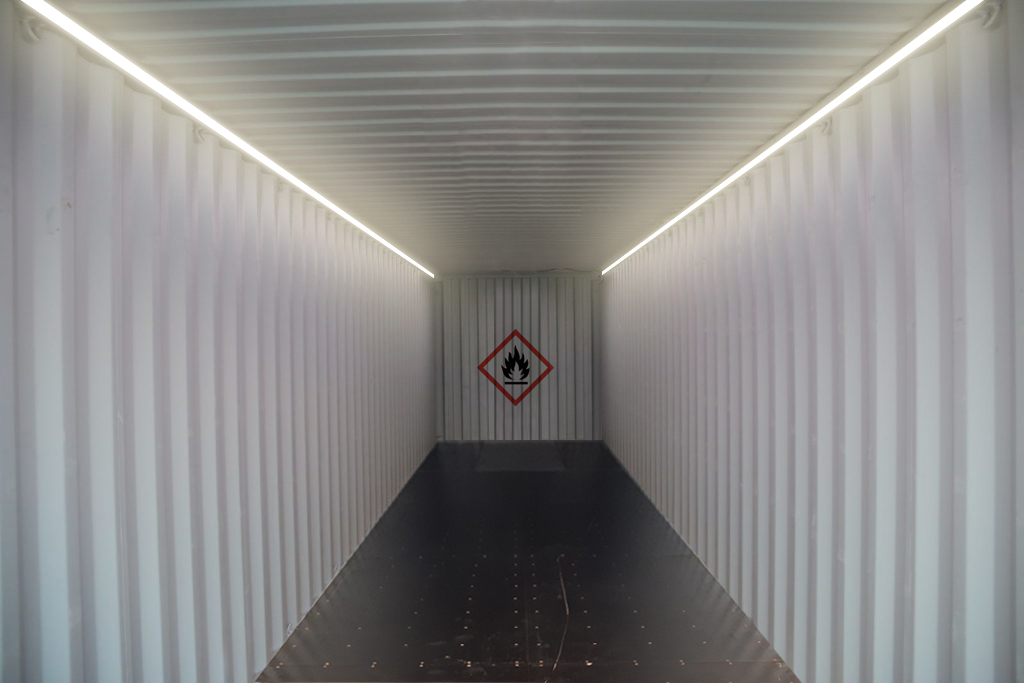
LED strip lighting offers uniform, shadow-free illumination that traditional point fixtures struggle to deliver in paint environments. When properly certified, strip systems also solve common booth problems like glare on wet coatings, inconsistent brightness, and difficult cleaning.
Key advantages include:
- Low thermal output with controlled surface temperature
- Continuous, even light distribution along walls and ceilings
- Fully sealed construction for washdown and solvent exposure
- Modular layouts that adapt to booth geometry
The result is lighting that supports both safety compliance and finish quality, not one at the expense of the other.
Certification Requirements for Explosion-Proof LED Strip Lighting
For global and industrial paint facilities, IECEx certification is the most widely accepted standard. It verifies that the LED strip system has been tested for explosive atmospheres and manufactured under audited quality systems.
Some facilities may also require ATEX compliance, particularly within the EU. In mixed-standard environments, request documentation that clearly maps IECEx markings to ATEX requirements.
Certification documents should clearly state:
- Protection method (such as encapsulation or increased safety)
- Approved gas group
- Temperature class (T-rating)
- Installation conditions
If any of these are missing, the product should not be installed in a paint booth.
Selecting the Correct Temperature Class (T-Rating)
Surface temperature control is critical in solvent-rich environments. The LED strip’s maximum surface temperature must stay below the auto-ignition temperature of the solvents used in the booth.
Most paint booths require T4 or cooler:
- T4: Max surface temperature 135°C
- T5: Max surface temperature 100°C
- T6: Max surface temperature 85°C
Choosing a cooler T-class adds margin for error, especially in booths with high ambient temperatures or continuous operation.
IP Rating and Chemical Resistance
Paint booths are aggressive environments. Lighting is exposed to overspray, solvents, and frequent high-pressure cleaning. Explosion-proof LED strip lighting should meet IP66 or IP67 at minimum.
Beyond the IP rating, material compatibility matters:
- Potting compounds must resist thinners and solvents
- Lenses should not haze or yellow over time
- Gaskets must tolerate repeated washdowns
Chemical resistance failures often appear months after installation, so verifying material data upfront prevents premature replacements.
Visual Performance for Paint Inspection
Explosion-proof does not mean visually compromised. Paint booths demand lighting that reveals defects clearly without introducing glare.
Recommended specifications:
- CRI ≥90 for accurate color rendering
- 4000–5000K for neutral, inspection-friendly light
- Diffused optics to reduce glare on wet surfaces
- Target 800–1,000 lux at the task plane
Uniformity matters as much as brightness. Even lighting prevents false shadows that can hide runs, fisheyes, or surface inconsistencies.
Installation and Maintenance Considerations
Well-designed explosion-proof LED strip systems simplify installation and reduce downtime.
Best practices include:
- Drivers located outside the hazardous zone when possible
- Certified junction boxes for local terminations
- Short run lengths to limit voltage drop
- Field-replaceable drivers and modular strip sections
Clear label plates and visible certification markings speed up inspections and reduce audit friction.
Practical Sizing Example for a Paint Booth
Booth size: 4 m × 6 m
Target illumination: 900 lux
Area: 24 m²
- Required lumens: ~21,600
- Apply loss factor (0.8): ~27,000 lumens
- LED strip output: ~1,200 lumens per meter
- Required length: ~24 meters of strip
Distribute strips along sidewalls and ceiling runs to balance uniformity and glare control. Split power feeds to maintain voltage stability across longer runs.
Documentation and Audit Readiness
An audit-ready lighting system is as much about paperwork as hardware.
Keep the following in one folder:
- IECEx certificate and declaration of conformity
- Product marking photos
- T-rating and IP rating confirmation
- Material compatibility statements
- Wiring diagrams and layout drawings
When inspectors can verify compliance quickly, inspections stay short and uneventful.
Key Takeaways for Explosion-Proof LED Strip Selection
Explosion-proof LED strip lighting works when safety, thermal control, sealing, and visual quality are treated as one system. Start with the hazardous zone, lock in the correct certification, control surface temperature, and verify material resistance. Then design the layout to deliver clean, uniform light that supports inspection accuracy.
When specified correctly, IECEx-certified explosion-proof LED strips turn paint booth lighting from a risk variable into a reliable part of the process, safer operations, faster audits, and consistently better finishes.