
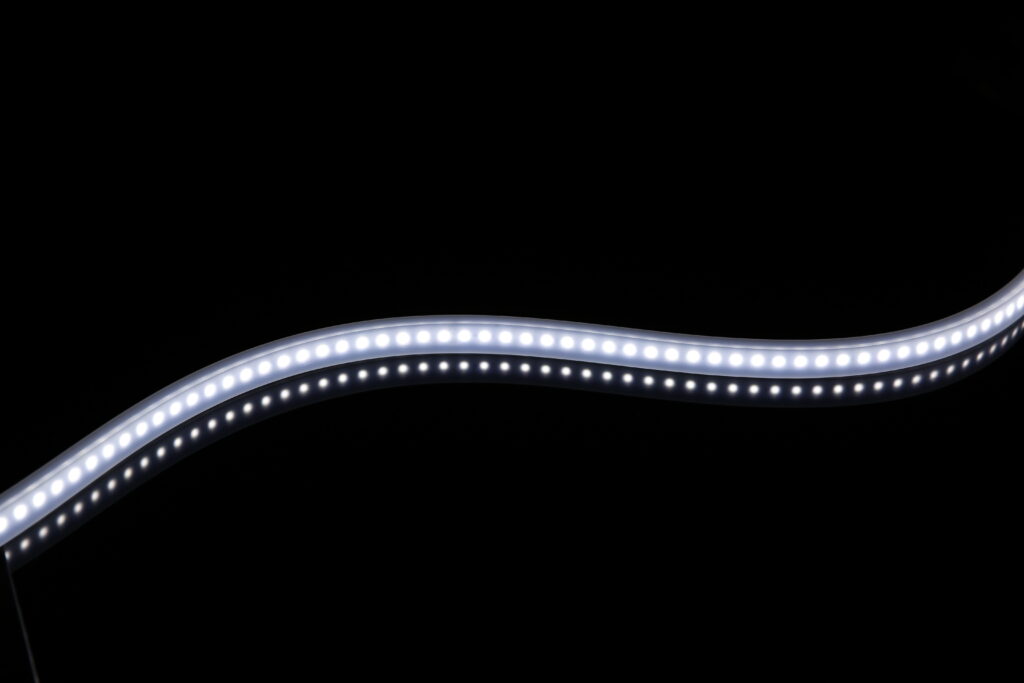
The Invisible Barrier Inside Every Ex-Proof LED Strip
What if the line between safe illumination and a catastrophic ignition came down to a sealed layer you never see? In hazardous environments, Ex-proof LED strip lighting relies on encapsulation to act as a silent safeguard, locking energy, heat, and electrical components inside a controlled envelope. This is the essence of the Ex m standard, not marketing language, but a proven engineering approach that keeps explosive atmospheres from ever finding a spark.
Encapsulation turns lighting systems into passive safety devices. When designed correctly, Ex m-rated LED strips don’t just survive hazardous areas, they actively prevent ignition by isolating every potential source of energy from the surrounding atmosphere.
Key Takeaways
• Understand how Ex m encapsulation prevents ignition in LED strip lighting
• Learn why encapsulation is critical for flexible and linear luminaires
• See how material choice affects thermal and electrical containment
• Apply Ex m decision logic when selecting lighting for Zones 1 and 2
• Avoid common compliance failures in hazardous lighting installations
Where Physics Meets Lighting Risk
Every hazardous site runs on controlled energy. Electrical current, heat dissipation, and reactive atmospheres coexist by necessity. Ex-proof LED strip lighting lives right at that intersection. A single exposed conductor, overheated driver, or degraded seal can be enough to trigger ignition.
That’s why Ex m exists.
Encapsulation works by permanently embedding live components inside a compound that resists flame propagation, limits surface temperature, and prevents gas or dust ingress. Even if a fault occurs inside the strip, the surrounding atmosphere never knows it happened.
Explosion physics are brutal. Gas expansion happens in milliseconds, and ignition temperatures are unforgiving. Ex m-rated LED strips are engineered so that no combination of electrical fault, thermal buildup, or mechanical stress can transmit enough energy outward to ignite the environment.
This isn’t about containing an explosion after it happens. It’s about making ignition physically impossible.
The Engineering Behind Ex m LED Strip Encapsulation
At its core, Ex m lighting design is about energy isolation. Every component inside an Ex-proof LED strip, from the PCB to the driver interface, is treated as a potential ignition source and sealed accordingly.
Encapsulation compounds are selected to do three things at once:
Absorb heat without cracking or shrinking
Maintain dielectric strength over time
Prevent gas diffusion, even under pressure
Advanced Ex-proof LED strips use layered encapsulation. The LED board is sealed first, then secondary barriers protect solder joints, and the outer jacket provides mechanical and chemical resistance. Each layer serves a different role, but together they create a complete ignition barrier.
Material science matters here. Silicone resins handle flexibility and vibration. Epoxy compounds provide mechanical strength and long-term stability. Hybrid systems balance thermal conductivity with flame resistance. The wrong choice leads to micro-cracks, trapped heat, or premature aging, all of which undermine certification.
This is why Ex m compliance is not just a label, it’s a design discipline.
Applying Ex m Standards in Real-World Lighting Design
Choosing Ex-proof LED strip lighting isn’t just about voltage or lumen output. The Ex m standard forces a different way of thinking.
Risk Level → Encapsulation Strategy
High-risk zones → Full encapsulation of all live parts, no serviceable components
Medium-risk zones → Encapsulated boards with protected terminations
Lower-risk zones → Encapsulation combined with additional ingress protection
In practice, Ex m LED strips are ideal where flexibility is required but flameproof enclosures are impractical. Walkways, handrails, under-equipment lighting, and retrofit applications all benefit from linear formats that still meet strict ignition prevention requirements.
Thermal management is the hidden challenge. Encapsulation traps heat, so Ex-proof LED strips must be designed with controlled power density, efficient heat paths, and conservative surface temperature limits. Ex m doesn’t forgive shortcuts here.
Implementation Checklist for Ex m LED Strip Lighting
Hazard Assessment
Confirm gas or dust group and temperature class
Define Zone classification and exposure duration
Strip Selection
Verify Ex m certification scope covers the full assembly
Confirm encapsulation compound compatibility with site chemicals
Installation Design
Avoid mechanical stress points that could damage encapsulation
Maintain minimum bend radii specified by the manufacturer
Validation
Confirm surface temperature under worst-case ambient conditions
Inspect terminations for encapsulation integrity
A common failure point is assuming encapsulation ends at the LED strip. It doesn’t. Transitions, connectors, and power feeds must maintain the same protection concept or the entire system is compromised.
When Standard Solutions Aren’t Enough
Not every hazardous environment behaves the same way. Dust-heavy facilities challenge encapsulation differently than gas-rich zones. Offshore installations introduce salt, vibration, and thermal cycling that can slowly degrade poorly chosen compounds.
Some engineers favor rigid encapsulation for absolute stability. Others prioritize flexible systems that move with structures and reduce mechanical fatigue. Ex m allows both approaches, but only when the materials and testing support the intent.
European Ex m interpretations tend to be stricter on material permanence. Other regions emphasize performance under fault conditions. For global projects, aligning these perspectives early avoids costly redesigns.
Emerging designs now integrate thermal monitoring and predictive maintenance into Ex-proof LED strips. While not required by Ex m, they add a layer of operational confidence in high-risk installations.
Building Long-Term Ex-Proof Lighting Confidence
Mastering Ex m lighting isn’t about memorizing standards. It’s about understanding how encapsulation behaves over time. Aging, thermal cycling, UV exposure, and chemical contact all test the integrity of an Ex-proof LED strip long after installation.
The most reliable systems are designed conservatively, tested aggressively, and installed with restraint. Over-driving LEDs or pushing bend limits may look fine on day one, but Ex m performance is measured in years, not hours.
The Path to Truly Explosion-Proof Illumination
Ex-proof LED strip lighting built to Ex m standards doesn’t rely on visible armor or heavy housings. Its strength lies in what you can’t see, sealed circuits, controlled heat, and encapsulated energy.
When applied correctly, Ex m turns flexible lighting into a passive safety system. No moving parts. No active suppression. Just physics, materials, and disciplined engineering working together.
If your operation depends on lighting in hazardous zones, the question isn’t whether you need Ex m encapsulation. It’s whether the system you’ve chosen truly respects it.