Technical Safety Concepts

Technical Safety Concepts

Intrinsically safe lighting for Brazil’s paint booths and flammable material warehouses

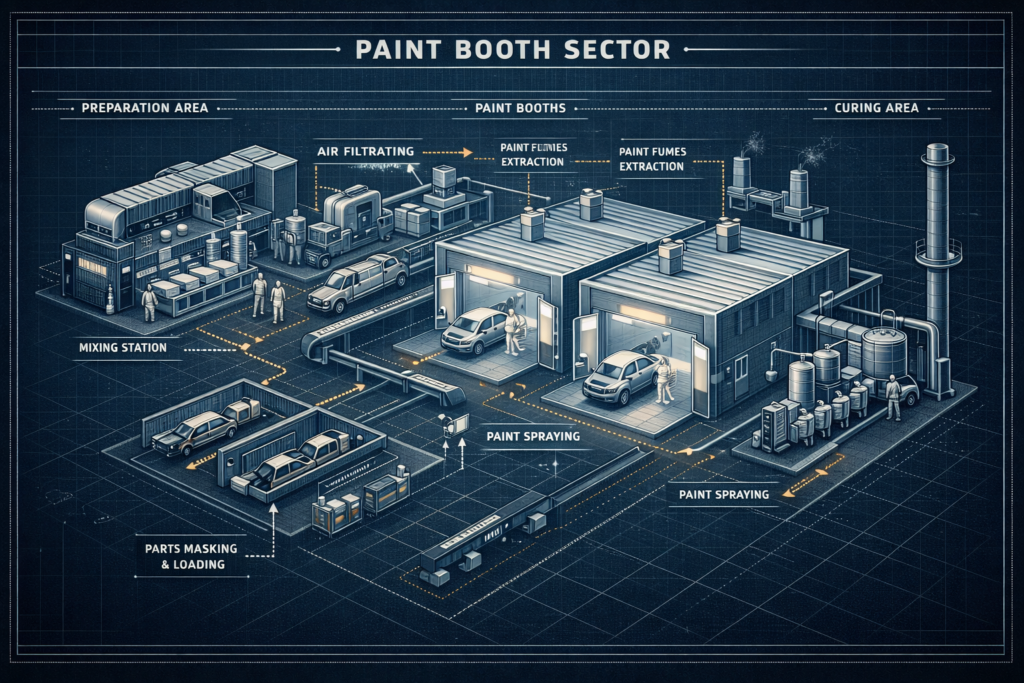
You usually notice the lighting problem before you say it out loud. A paint booth starts looking a little dim on one side, the finish check gets harder, somebody complains about shadows on the panel edges, and then maintenance finds a fixture that was never really meant for that environment in the first place. In a flammable-material warehouse, it’s the same kind of slow drift. A light fails, a replacement gets rushed in, and suddenly a hazardous-area decision is being treated like a basic maintenance swap. That’s where things go sideways. Brazil’s NR-20 covers work involving flammables and combustibles, and NR-10 covers electrical installations and services, including the need for certified electrical equipment and materials in classified areas. Spray application with flammable or combustible materials is also widely treated as a fire and explosion hazard, not just a visibility issue. That matters because a lot of buyers start with the wrong question. They ask for brighter fixtures, cheaper fixtures, or faster lead times. The real first question is simpler and way more important, what exactly is the hazardous area, and what protection concept is actually required there? In Brazil, that answer sits inside the NR-20 and NR-10 framework, and in the ABNT/IEC 60079 family used for classified areas, installation design, and inspection. Why this keeps becoming a headache in paint booths and solvent storage areas Paint booths are messy in a very specific way. You’re dealing with flammable vapors, overspray, cleaning chemicals, airflow issues, and the constant pressure to keep production moving. So when a luminaire starts fogging, flickering, or losing output, the temptation is to treat it like any other industrial light. Swap it fast, keep the line running, deal with the paperwork later. That shortcut can quietly create a much bigger problem than the bad fixture you started with. (nfpa.org) Warehouses for flammable materials can fool people too. From the outside, they often look calmer than process areas, so teams assume the lighting spec can be simpler. But explosive atmospheres are about the probability and duration of a hazardous mixture being present, and Brazil’s zoning approach reflects exactly that with Zones 0, 1, and 2 for gas and vapor risks, and Zones 20, 21, and 22 for combustible dusts. That means the “warehouse” label alone tells you almost nothing. The way materials are stored, transferred, sampled, ventilated, and cleaned changes the answer. (Serviços e Informações do Brasil) The phrase “intrinsically safe lights” can send you in the wrong direction Here’s the part buyers learn the hard way. In the market, people often use “intrinsically safe lights” as a catch-all phrase for any hazardous-area lighting. The standards do not use it that way. IEC 60079-11 is specifically for protection by intrinsic safety “i”, while the same standards family also covers flameproof enclosures “d”, pressurized enclosures “p”, increased safety “e”, and dust ignition protection by enclosure “t”, along with installation design and inspection requirements. (IECEx) So if you’re sourcing paint booth lighting in Brazil or lighting for flammable material warehouses, don’t let the keyword drive the engineering. Let the area classification drive it. In practice, truly intrinsic-safe lighting is more commonly associated with low-energy devices and some portable or task-oriented equipment, while fixed general lighting in booths and storage areas often ends up using other certified Ex protection concepts that better fit the power level, enclosure needs, and environmental abuse of the application. That last point is an engineering inference from how the standards divide protection methods and how Brazil requires certified equipment in classified areas. (IECEx) What a paint booth usually needs, and what buyers miss If you’re lighting a booth where solvent-based coatings are sprayed, you’re not just trying to make the room bright. You’re trying to keep color inspection reliable, reduce shadows, avoid glare on wet surfaces, and do all that without introducing an ignition source or a maintenance nightmare. That’s why the right luminaire choice usually comes after the hazardous-area study, not before it. (nfpa.org) A common mistake is buying on body style alone. Someone sees a rugged LED fixture with a nice datasheet, decent IP rating, and good lumen output, and assumes it’s close enough. It isn’t. For Brazilian facilities, you want a luminaire whose certification, protection concept, and marking actually match the classified zone and site conditions, and you want that supported by documentation that stands up inside your electrical dossier and inspection routine. NR-10 is very clear that certified electrical equipment and materials in classified areas belong in the documentation package. Another thing people miss is maintenance access. If a booth light needs constant opening, awkward disassembly, or frequent replacement, you’ve built future risk into the project. The smarter choice is usually the one that gives you stable output, sealed optics, chemical resistance, and a mounting arrangement that makes inspections less painful. This isn’t a flexible strip lighting job, by the way. In booths and solvent-heavy spaces, that kind of solution usually belongs in the “sounds easy, ages badly” category. Why warehouse projects go wrong when you copy the booth spec You’d think a flammable-material warehouse would just use the same lighting approach as the booth next door. That’s where copy-paste specs start costing money. A storage area with sealed drums and good ventilation is not the same as a room with frequent transfer, decanting, spill exposure, or vapor release points. The hazard is tied to the actual probability of an explosive atmosphere, not the name on the door. (Serviços e Informações do Brasil) And not every warehouse hazard is a vapor hazard. Brazil’s classified-area framework also deals with combustible dusts, which matters if your “warehouse” includes powders, residues, fibers, or dusty handling points. If you skip that distinction, you can end up buying a fixture that sounds right in a sales call and is still wrong for the zone. That’s a nasty surprise to discover after installation. (Serviços e Informações do Brasil) The better approach is boring, honestly, but boring is good here. Break the warehouse into real operating conditions. Receiving,

Technical Safety Concepts

Explosion-proof fixtures for sugar mills and ethanol plants in Brazil

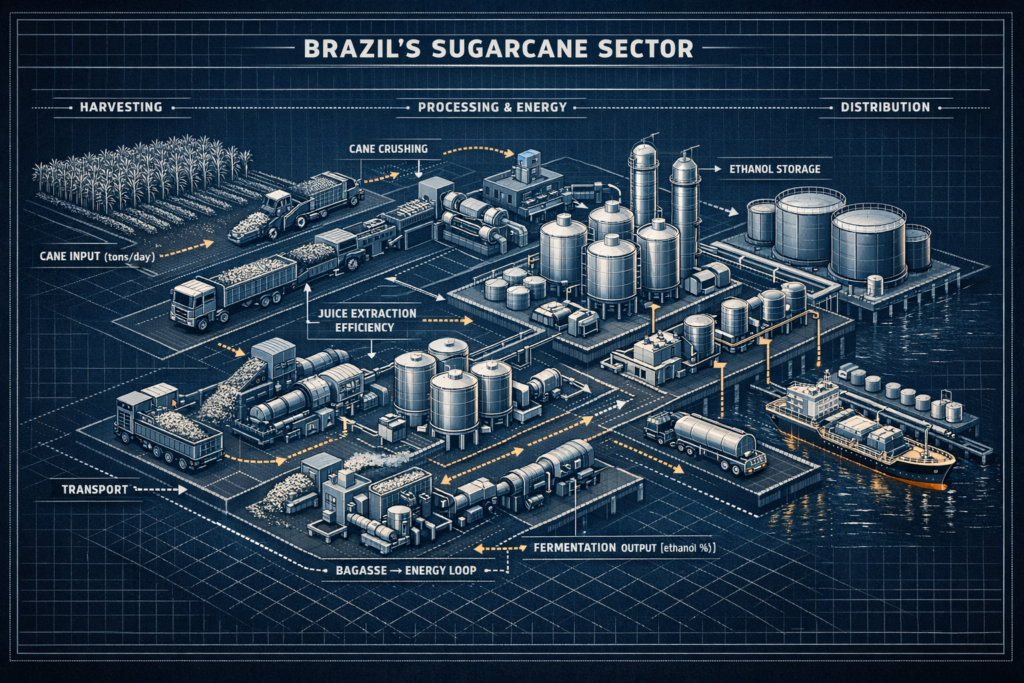
Brazil’s sugarcane sector runs at a scale that can make small equipment decisions turn into very expensive mistakes. Conab’s latest published estimate for the 2025/26 sugarcane crop was 668.8 million tons, which tells you everything about the size of the industrial footprint you’re dealing with, mills, storage, handling systems, fermentation, distillation, loading, utilities, all of it. In a sector that big, lighting isn’t a side purchase. It sits right inside safety, uptime, and maintenance strategy. (Serviços e Informações do Brasil) And this is where a lot of facilities get tripped up. Somebody treats lighting as a catalog exercise, compares wattage, lumen output, and price, then assumes the job is done. But in a sugar mill or ethanol plant, the real question is tougher: will this fixture stay safe and reliable in a place where you may have combustible sugar dust, flammable vapors, washdowns, vibration, heat, corrosion, and maintenance teams that are already stretched thin? That’s why the phrase explosion-proof fixtures matters so much in Brazil’s sugar and ethanol market. It isn’t just about buying a tougher light. It’s about matching the fixture to the actual hazard, the actual operating conditions, and the actual compliance burden. Get that right, and you reduce nuisance failures, relamping headaches, and the kind of risk that keeps plant managers awake. Get it wrong, and a cheap fixture can become the most expensive line item in the project. Why the hazard doesn’t go away just because the plant is experienced Sugar processing can look deceptively familiar. Conveyors move, mills run, transfer points load and unload, dust collectors hum along, and people get used to the environment. That’s part of the problem. OSHA’s combustible-dust guidance is blunt on this point: combustible material in finely divided form can become explosible when suspended in air under the right conditions. Sugar dust fits that logic. And the 2008 Imperial Sugar disaster in the United States, which killed 14 workers and injured 36, is still one of the clearest reminders of what happens when dust hazards, housekeeping, and ignition-source control get treated like background issues instead of design issues. (OSHA) Now layer ethanol onto that picture. In ethanol plants, you’re no longer dealing mainly with dust zones around handling and transfer points. You’re also dealing with flammable liquids and vapors around production, storage, transfer, and associated process areas. Brazil’s NR-20 explicitly applies to extraction, production, storage, transfer, handling, and manipulation of flammables and combustible liquids, and it requires risk analysis, documented maintenance, and periodic inspection for relevant installations. That changes the lighting conversation fast, because a fixture decision is no longer just electrical, it’s part of process safety management. (Serviços e Informações do Brasil) This is also why these hazards persist. Not because managers don’t care, but because the risks are spread across ordinary operations. Dust settles on structures and cable runs. Vapors are handled as part of normal throughput. Temporary fixes stay in place too long. A fixture that looks fine in a warehouse gets copied into a classified area because it’s “basically the same layout.” That kind of thinking is common, and honestly, it’s understandable. Plants are busy. Procurement is under pressure. Downtime costs real money. But hazardous-area lighting punishes shortcuts. The Brazil-specific point buyers can’t ignore In Brazil, this is not just a best-practice issue. NR-10 says materials, devices, equipment, and systems intended for electrical installations in environments with potentially explosive atmospheres must be evaluated for conformity within the Brazilian certification system. It also states that electrical installations in classified areas or places with elevated fire or explosion risk must adopt protective devices such as alarms and automatic disconnection to prevent abnormal operating conditions. (Serviços e Informações do Brasil) That means “explosion-proof” on a brochure is not enough. For equipment certification in Brazil, Inmetro’s framework is the reference point. Inmetro’s own guidance ties the country’s conformity requirements for electrical equipment in explosive atmospheres to Portaria Inmetro nº 115/2022, and it points buyers to ABNT NBR IEC 60079-10-1 for gas area classification, ABNT NBR IEC 60079-10-2 for combustible dust area classification, and ABNT NBR IEC 60079-14 for design, selection, and installation of electrical systems in explosive atmospheres. (Serviços e Informações do Brasil) So the first lesson is simple. Don’t start by comparing fixtures. Start by confirming the area classification study and the certification path that applies in Brazil. That sounds obvious, but it gets skipped more than people admit. A facility manager may be handed three proposals for sugar mill explosion-proof lighting, and all three look polished. Nice renderings. Nice LED claims. Lots of talk about efficiency. But if one supplier is vague on Inmetro certification, another is fuzzy about dust versus gas classification, and the third can’t clearly map the fixture to the actual area schedule, then you’re not comparing apples to apples. You’re comparing marketing. What actually makes one fixture better than another in a sugar mill or ethanol plant A strong fixture choice usually wins on six things, not one. The fixture types that usually make sense, and the ones that usually don’t For most sugar and ethanol sites, the conversation usually lands on a few core categories: hazardous-area high bays for larger process spaces, explosion-protected flexible strip luminaires for walkways and platforms, floodlights for outdoor process and loading areas, and properly rated emergency fixtures or escape-route lighting where required by the plant design. That mix makes sense because the site itself is mixed. You’re dealing with tall spaces, narrow access routes, outdoor exposure, utility areas, and process zones that don’t all have the same risk profile. One fixture family for the entire plant sounds efficient, but it usually leads to overspecifying safe areas and underserving difficult ones. You end up paying too much in some places and not getting enough resilience in others. Not great. And this is the point where flexible strip lighting should be taken off the table. For this application, it’s basically not the right tool. Sugar mills and ethanol plants need industrial, fixed, certified lighting solutions with robust housings, defensible

Technical Safety Concepts

Offshore explosion-proof lighting for Brazil’s oil & gas platforms and FPSOs

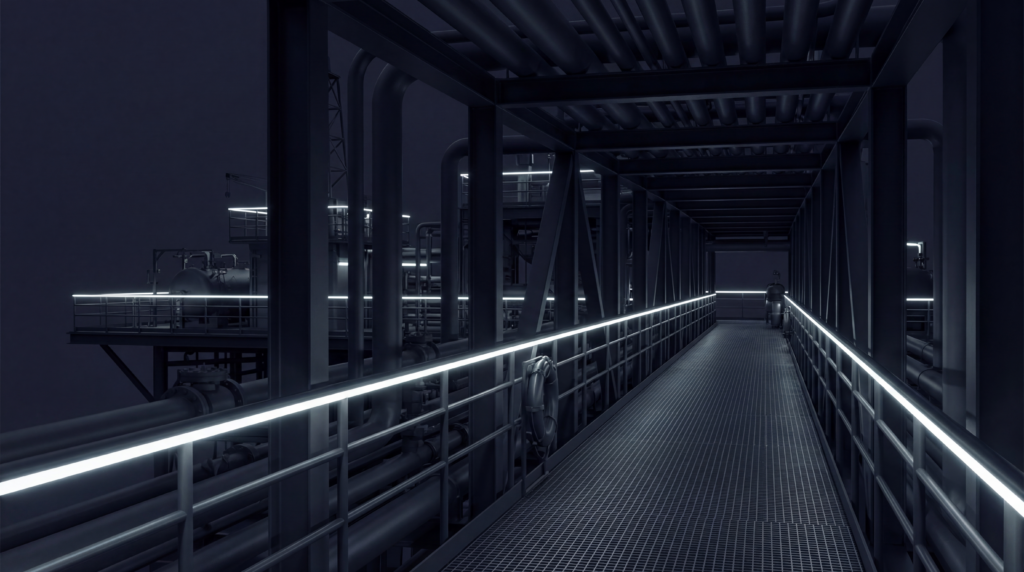
If you work on Brazil offshore projects, you already know the scale is getting bigger, not simpler. Petrobras said pre-salt made up 82% of its total production in 2025, and two new platforms started operating that year in the Santos Basin pre-salt. In Búzios, production hit the 1 million barrels per day mark in October 2025, and the P-78 started up at the end of that year as the field’s seventh FPSO. When that much production depends on people moving safely through topsides at night, lighting stops being a background purchase and becomes an operational decision. (Agência) Why this is still a live problem on offshore platforms A lot of teams still treat hazardous-area lighting like a checkbox. The fixture has an Ex certificate, the datasheet looks fine, the lumen number looks healthy, and everyone moves on. Then the unit gets offshore and the real problems show up: glare on wet grating, dark pockets at valve stations, fittings that hate salt and condensation, cable entries that are annoying to inspect, and walkways that technically have light but still don’t feel readable when somebody is doing a 2 a.m. inspection round. That gap exists because offshore lighting has to solve two jobs at once. It has to be safe in a potentially explosive atmosphere, and it has to help a tired human being see enough detail to move, inspect, confirm, and leave without improvising. The standards world reflects that. IECEx is built around Ex equipment and installations, and the IEC 60079 family covers general requirements, area classification, installation, inspection, maintenance, and repair, not just product certification in isolation. (IECEx) Brazil’s own platform rule, NR-37, comes at the same issue from the worker-safety side. The regulation sets minimum safety, health, and living-condition requirements for work aboard oil platforms in Brazilian jurisdictional waters, and the 2022 revision was explicitly harmonized with ANP risk management and the updated NR-01 approach. That matters because lighting decisions on a platform are never only about hardware. They sit inside a bigger risk-management system. (Serviços e Informações do Brasil) Why Brazil makes the buying decision tighter This is where some offshore projects get tripped up. Teams assume IECEx or ATEX paperwork is the whole story, but Brazil has its own conformity path. Inmetro’s Portaria 115/2022 is the current consolidated framework for electrical equipment used in explosive atmospheres, and Inmetro’s own guidance points buyers toward ABNT NBR IEC 60079-10-1 and 60079-10-2 for area classification, plus ABNT NBR IEC 60079-14 for design, selection, and installation of electrical systems in classified areas. (Inmetro) That means a lighting package for a Brazil FPSO is not just a photometric exercise. You’re checking the classified area, the actual Ex protection concept, the installation method, the cable entries, the inspection philosophy, and the local conformity route. Inmetro also says imported products that already hold IECEx or ATEX certifications can be submitted to an Inmetro-accredited product certification body, which reviews those test reports and the manufacturer’s production system and may still require additional evaluation under Brazilian requirements. So “already certified somewhere else” is helpful, but it’s not the same thing as “ready to buy for Brazil.” (Serviços e Informações do Brasil) There’s one nuance that really matters on FPSO projects. Inmetro also states that electrical Ex equipment acquired abroad and installed on offshore units during fabrication in a foreign shipyard can fall outside compulsory certification in that specific context, with acceptance tied to supplier criteria and the certifications adopted by naval classification societies when the unit enters or begins operation in Brazilian waters. That sounds like a loophole until you live through a project and realize it’s actually a coordination problem. Engineering, procurement, yard construction, class, operator standards, and Brazil entry requirements all need to line up early, or the lighting package becomes a documentation headache late in the game. (Serviços e Informações do Brasil) What good offshore explosion-proof lighting actually needs to solve Where handrail path lighting actually earns its keep This is where your use-case gets interesting. For a pipe-rack corridor on an offshore platform, a certified handrail path light can be genuinely useful for routine night walkdowns. Not because it looks modern. Because it turns a long, repetitive walkway into a readable route. That sounds almost too simple, but on offshore routes the real win is often clarity, not brightness. Picture the usual night round. The inspector is moving past supports, valves, cable trays, and intermittent equipment shadows. With only widely spaced bulkheads or floods, the route can feel choppy. You see bright spots, then dead zones, then another bright patch. A properly selected flexible linear path-light system along the handrail helps stitch that route together, so the walkway reads as one continuous path instead of a string of isolated pools of light. That can reduce the urge to bring in temporary lighting just to make the walk feel safe enough to work. But this is the part people skip, and it matters. A handrail strip is not a magic replacement for area lighting or task lighting. It’s a layer. A good one, if used well. It helps with route guidance, edge recognition, and consistent visual adaptation along long corridors. It does not replace the need to identify a leaking flange, read a local instrument, or inspect a valve position in detail. If somebody tries to use one product to do all three jobs, the design usually gets sloppy. What safety officers and engineers should check before approving a fixture Start with the area classification and actual Ex marking, not the marketing label. Inmetro’s guidance points straight to ABNT NBR IEC 60079-10-1 and 60079-10-2 for classification, and ABNT NBR IEC 60079-14 for the installation side. So the question is not “Is this explosion-proof?” The question is “Is this specific fixture, with this specific protection concept and temperature behavior, appropriate for this exact zone and installation method?” (Serviços e Informações do Brasil) Then look at the Brazil path. For equipment going through local conformity, ask early how the supplier is handling Inmetro, which

Scroll to Top