If you work on Brazil offshore projects, you already know the scale is getting bigger, not simpler. Petrobras said pre-salt made up 82% of its total production in 2025, and two new platforms started operating that year in the Santos Basin pre-salt.
In Búzios, production hit the 1 million barrels per day mark in October 2025, and the P-78 started up at the end of that year as the field’s seventh FPSO. When that much production depends on people moving safely through topsides at night, lighting stops being a background purchase and becomes an operational decision. (Agência)
Why this is still a live problem on offshore platforms
A lot of teams still treat hazardous-area lighting like a checkbox. The fixture has an Ex certificate, the datasheet looks fine, the lumen number looks healthy, and everyone moves on. Then the unit gets offshore and the real problems show up: glare on wet grating, dark pockets at valve stations, fittings that hate salt and condensation, cable entries that are annoying to inspect, and walkways that technically have light but still don’t feel readable when somebody is doing a 2 a.m. inspection round.
That gap exists because offshore lighting has to solve two jobs at once. It has to be safe in a potentially explosive atmosphere, and it has to help a tired human being see enough detail to move, inspect, confirm, and leave without improvising. The standards world reflects that. IECEx is built around Ex equipment and installations, and the IEC 60079 family covers general requirements, area classification, installation, inspection, maintenance, and repair, not just product certification in isolation. (IECEx)
Brazil’s own platform rule, NR-37, comes at the same issue from the worker-safety side. The regulation sets minimum safety, health, and living-condition requirements for work aboard oil platforms in Brazilian jurisdictional waters, and the 2022 revision was explicitly harmonized with ANP risk management and the updated NR-01 approach. That matters because lighting decisions on a platform are never only about hardware. They sit inside a bigger risk-management system. (Serviços e Informações do Brasil)
Why Brazil makes the buying decision tighter
This is where some offshore projects get tripped up. Teams assume IECEx or ATEX paperwork is the whole story, but Brazil has its own conformity path. Inmetro’s Portaria 115/2022 is the current consolidated framework for electrical equipment used in explosive atmospheres, and Inmetro’s own guidance points buyers toward ABNT NBR IEC 60079-10-1 and 60079-10-2 for area classification, plus ABNT NBR IEC 60079-14 for design, selection, and installation of electrical systems in classified areas. (Inmetro)
That means a lighting package for a Brazil FPSO is not just a photometric exercise. You’re checking the classified area, the actual Ex protection concept, the installation method, the cable entries, the inspection philosophy, and the local conformity route. Inmetro also says imported products that already hold IECEx or ATEX certifications can be submitted to an Inmetro-accredited product certification body, which reviews those test reports and the manufacturer’s production system and may still require additional evaluation under Brazilian requirements. So “already certified somewhere else” is helpful, but it’s not the same thing as “ready to buy for Brazil.” (Serviços e Informações do Brasil)
There’s one nuance that really matters on FPSO projects. Inmetro also states that electrical Ex equipment acquired abroad and installed on offshore units during fabrication in a foreign shipyard can fall outside compulsory certification in that specific context, with acceptance tied to supplier criteria and the certifications adopted by naval classification societies when the unit enters or begins operation in Brazilian waters. That sounds like a loophole until you live through a project and realize it’s actually a coordination problem. Engineering, procurement, yard construction, class, operator standards, and Brazil entry requirements all need to line up early, or the lighting package becomes a documentation headache late in the game. (Serviços e Informações do Brasil)
What good offshore explosion-proof lighting actually needs to solve
- The first mistake is choosing fixtures by the headline claim, usually “explosion-proof LED,” and not by the real duty. On a platform or FPSO, the fixture has to survive offshore reality. DNV guidance for offshore electrical equipment stresses suitability for offshore use, protection against corrosion, and attention to humidity, condensation, mechanical protection, and environmental conditions where equipment is externally exposed. That’s not glamorous, but it’s exactly where bad lighting decisions age fast. (gauthiersrental.com)
- The second mistake is thinking more light automatically means better visibility. It doesn’t. On pipe racks and processing decks, the problem is often contrast, shadow, and orientation. A flood of harsh light can make a handrail sparkle and a gauge disappear. You want people to identify edges, valves, signage, step changes, and obstructions without hunting for them. That’s why the useful conversation is not “How many lumens?” It’s “Can the operator read the route and the task without adding temporary lights or slowing down to guess?”
- The third mistake is ignoring maintenance from day one. IECEx points directly to IEC 60079-17 for inspection and maintenance, and to IEC 60079-19 for repair and overhaul. In plain English, the fixture doesn’t stop being an Ex issue after commissioning. If you choose a unit that is miserable to inspect, awkward to isolate, or dependent on a supply chain that drags, the maintenance burden will come back and bite you later. (IECEx)
Where handrail path lighting actually earns its keep
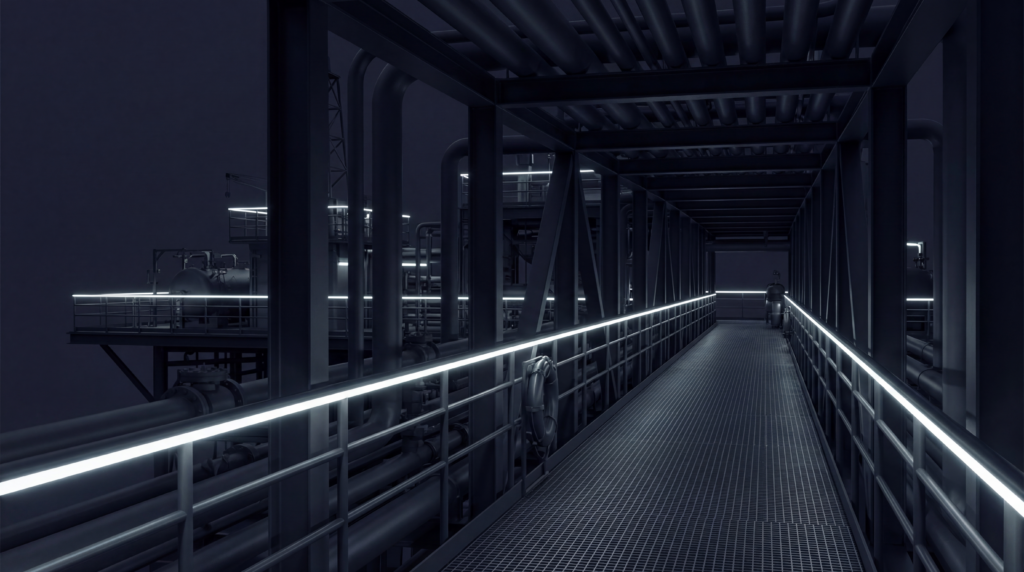
This is where your use-case gets interesting. For a pipe-rack corridor on an offshore platform, a certified handrail path light can be genuinely useful for routine night walkdowns. Not because it looks modern. Because it turns a long, repetitive walkway into a readable route. That sounds almost too simple, but on offshore routes the real win is often clarity, not brightness.
Picture the usual night round. The inspector is moving past supports, valves, cable trays, and intermittent equipment shadows. With only widely spaced bulkheads or floods, the route can feel choppy. You see bright spots, then dead zones, then another bright patch. A properly selected flexible linear path-light system along the handrail helps stitch that route together, so the walkway reads as one continuous path instead of a string of isolated pools of light. That can reduce the urge to bring in temporary lighting just to make the walk feel safe enough to work.
But this is the part people skip, and it matters. A handrail strip is not a magic replacement for area lighting or task lighting. It’s a layer. A good one, if used well. It helps with route guidance, edge recognition, and consistent visual adaptation along long corridors. It does not replace the need to identify a leaking flange, read a local instrument, or inspect a valve position in detail. If somebody tries to use one product to do all three jobs, the design usually gets sloppy.
What safety officers and engineers should check before approving a fixture
Start with the area classification and actual Ex marking, not the marketing label. Inmetro’s guidance points straight to ABNT NBR IEC 60079-10-1 and 60079-10-2 for classification, and ABNT NBR IEC 60079-14 for the installation side. So the question is not “Is this explosion-proof?” The question is “Is this specific fixture, with this specific protection concept and temperature behavior, appropriate for this exact zone and installation method?” (Serviços e Informações do Brasil)
Then look at the Brazil path. For equipment going through local conformity, ask early how the supplier is handling Inmetro, which OCP is involved, and what evidence package already exists from IECEx or ATEX. If the equipment is tied to a foreign-yard FPSO build, check that the project team has aligned the yard acceptance basis, class requirements, operator standards, and Brazil-entry assumptions. This is the kind of issue that feels administrative until it suddenly affects schedule. (Serviços e Informações do Brasil)
After that, get practical. Ask where the shadows will land. Ask whether the fixture helps or hurts visual adaptation on long corridors. Ask how it behaves near reflective pipework and wet grating. Ask whether the mounting system will stay put after vibration, washdown, and repeated nearby maintenance activity. Ask whether the cable glands and connections will still be easy to inspect after a year offshore. These are not fussy questions. This is the stuff that separates a pretty lighting layout from a useful one.
And don’t forget the people piece. IECEx has expanded beyond equipment into service facilities and personnel competence because hazardous-area performance depends on more than what comes out of the box. Offshore lighting stays safe when competent people install it correctly, inspect it properly, and repair it without improvisation. (IECEx)
The bigger point
The reason hazards persist on Brazil platforms and FPSOs is not that the industry lacks standards. It has plenty. NR-37, Inmetro conformity rules, IECEx, IEC 60079, class requirements, operator specs, all of that exists. The problem is that lighting still gets pushed into the “commodity” bucket too often, even though it sits right at the intersection of process safety, occupational safety, maintainability, and uptime. (Serviços e Informações do Brasil)
When you choose the right lighting, you’re not just avoiding ignition risk. You’re reducing hesitation on night rounds. You’re making route-following more intuitive. You’re cutting the temptation to stage temporary lights in places where people would rather not. You’re giving operators a little more confidence in a place where small bits of confidence matter a lot. That’s not a soft benefit. On a large offshore asset, it adds up to better routine inspections, fewer workarounds, and a system that feels like it was designed for the job instead of merely approved for it.
That’s why the smartest offshore lighting decisions in Brazil usually look boring on the purchase order. The winning fixture is rarely the one with the flashiest brochure. It’s the one that matches the classified area, survives the marine environment, fits the local conformity path, gives you maintainable installation details, and helps a real person see the route clearly at night. On a platform or FPSO, that’s the standard worth buying to.