You usually notice the lighting problem before you say it out loud. A paint booth starts looking a little dim on one side, the finish check gets harder, somebody complains about shadows on the panel edges, and then maintenance finds a fixture that was never really meant for that environment in the first place. In a flammable-material warehouse, it’s the same kind of slow drift.
A light fails, a replacement gets rushed in, and suddenly a hazardous-area decision is being treated like a basic maintenance swap. That’s where things go sideways. Brazil’s NR-20 covers work involving flammables and combustibles, and NR-10 covers electrical installations and services, including the need for certified electrical equipment and materials in classified areas. Spray application with flammable or combustible materials is also widely treated as a fire and explosion hazard, not just a visibility issue.
That matters because a lot of buyers start with the wrong question. They ask for brighter fixtures, cheaper fixtures, or faster lead times. The real first question is simpler and way more important, what exactly is the hazardous area, and what protection concept is actually required there? In Brazil, that answer sits inside the NR-20 and NR-10 framework, and in the ABNT/IEC 60079 family used for classified areas, installation design, and inspection.
Why this keeps becoming a headache in paint booths and solvent storage areas
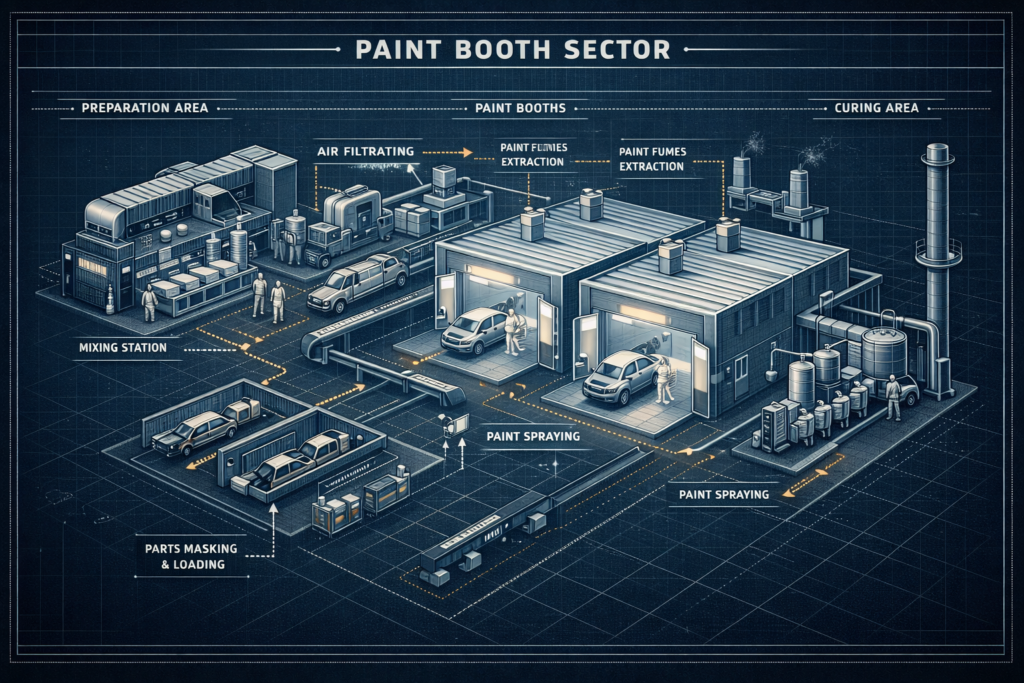
Paint booths are messy in a very specific way. You’re dealing with flammable vapors, overspray, cleaning chemicals, airflow issues, and the constant pressure to keep production moving. So when a luminaire starts fogging, flickering, or losing output, the temptation is to treat it like any other industrial light. Swap it fast, keep the line running, deal with the paperwork later. That shortcut can quietly create a much bigger problem than the bad fixture you started with. (nfpa.org)
Warehouses for flammable materials can fool people too. From the outside, they often look calmer than process areas, so teams assume the lighting spec can be simpler. But explosive atmospheres are about the probability and duration of a hazardous mixture being present, and Brazil’s zoning approach reflects exactly that with Zones 0, 1, and 2 for gas and vapor risks, and Zones 20, 21, and 22 for combustible dusts. That means the “warehouse” label alone tells you almost nothing. The way materials are stored, transferred, sampled, ventilated, and cleaned changes the answer. (Serviços e Informações do Brasil)
The phrase “intrinsically safe lights” can send you in the wrong direction
Here’s the part buyers learn the hard way. In the market, people often use “intrinsically safe lights” as a catch-all phrase for any hazardous-area lighting. The standards do not use it that way. IEC 60079-11 is specifically for protection by intrinsic safety “i”, while the same standards family also covers flameproof enclosures “d”, pressurized enclosures “p”, increased safety “e”, and dust ignition protection by enclosure “t”, along with installation design and inspection requirements. (IECEx)
So if you’re sourcing paint booth lighting in Brazil or lighting for flammable material warehouses, don’t let the keyword drive the engineering. Let the area classification drive it. In practice, truly intrinsic-safe lighting is more commonly associated with low-energy devices and some portable or task-oriented equipment, while fixed general lighting in booths and storage areas often ends up using other certified Ex protection concepts that better fit the power level, enclosure needs, and environmental abuse of the application. That last point is an engineering inference from how the standards divide protection methods and how Brazil requires certified equipment in classified areas. (IECEx)
What a paint booth usually needs, and what buyers miss
If you’re lighting a booth where solvent-based coatings are sprayed, you’re not just trying to make the room bright. You’re trying to keep color inspection reliable, reduce shadows, avoid glare on wet surfaces, and do all that without introducing an ignition source or a maintenance nightmare. That’s why the right luminaire choice usually comes after the hazardous-area study, not before it. (nfpa.org)
A common mistake is buying on body style alone. Someone sees a rugged LED fixture with a nice datasheet, decent IP rating, and good lumen output, and assumes it’s close enough. It isn’t.
For Brazilian facilities, you want a luminaire whose certification, protection concept, and marking actually match the classified zone and site conditions, and you want that supported by documentation that stands up inside your electrical dossier and inspection routine. NR-10 is very clear that certified electrical equipment and materials in classified areas belong in the documentation package.
Another thing people miss is maintenance access. If a booth light needs constant opening, awkward disassembly, or frequent replacement, you’ve built future risk into the project. The smarter choice is usually the one that gives you stable output, sealed optics, chemical resistance, and a mounting arrangement that makes inspections less painful. This isn’t a flexible strip lighting job, by the way. In booths and solvent-heavy spaces, that kind of solution usually belongs in the “sounds easy, ages badly” category.
Why warehouse projects go wrong when you copy the booth spec
You’d think a flammable-material warehouse would just use the same lighting approach as the booth next door. That’s where copy-paste specs start costing money. A storage area with sealed drums and good ventilation is not the same as a room with frequent transfer, decanting, spill exposure, or vapor release points. The hazard is tied to the actual probability of an explosive atmosphere, not the name on the door. (Serviços e Informações do Brasil)
And not every warehouse hazard is a vapor hazard. Brazil’s classified-area framework also deals with combustible dusts, which matters if your “warehouse” includes powders, residues, fibers, or dusty handling points. If you skip that distinction, you can end up buying a fixture that sounds right in a sales call and is still wrong for the zone. That’s a nasty surprise to discover after installation. (Serviços e Informações do Brasil)
The better approach is boring, honestly, but boring is good here. Break the warehouse into real operating conditions. Receiving, storage, transfer points, sampling points, waste handling, and maintenance corners may not all need the same answer. Once you do that, the lighting layout gets more honest, and the budget usually gets smarter too.
What you should ask a supplier before you approve anything
Start with the exact Ex marking and the current Brazilian certification status. Don’t settle for vague language like “hazardous rated” or “safe for flammable areas.” Ask for the actual protection concept, the zone suitability, the installation limitations, and the Inmetro-related certification evidence or traceable certificate details. Inmetro’s conformity rules and certified-products system are part of the Brazilian compliance picture for electrical equipment used in explosive atmospheres. (InMetro)
Then ask a question sales teams sometimes hate, what conditions would make this fixture the wrong choice? That one is gold. A serious supplier should be able to tell you about ambient temperature limits, chemical exposure issues, lens material limitations, cleaning restrictions, mounting constraints, and whether the fitting is meant for fixed general illumination or only for a narrower use case.
Also ask how the luminaire supports inspection and maintenance. Brazil’s standards culture around classified areas is not just about buying certified gear once and walking away. The framework also points to design, installation, inspection, and maintenance as an ongoing process. If the vendor can’t talk clearly about those steps, that’s not a small red flag, it’s the whole parade. (IECEx)
Why the right lighting choice pays off in ways people don’t notice on day one
The obvious win is safety, and that’s the big one. But day to day, good hazardous-area lighting also makes your operation less annoying. Inspectors can actually see coating defects. Warehouse staff can read labels and spot residue or leaks sooner. Maintenance stops becoming a cycle of rushed fixes and improvised substitutions.
There’s a resilience angle too. Fundacentro’s discussion of classified areas makes the economic side pretty plain, explosions and fires are not only human tragedies, they also bring ugly financial consequences. So the value of the right fixture is not just in lumens, wattage, or payback math. It’s in avoiding the kind of shutdown that makes everyone in the building wish someone had been less casual six months earlier. (Serviços e Informações do Brasil)
What a smart Brazil project actually looks like
A smart project usually starts with a facility admitting one uncomfortable truth. The original lighting spec may have been too generic. Once that’s on the table, the path gets clearer. Review the materials handled under the NR-20 lens, confirm the hazardous-area classification, align the lighting with the correct Ex protection concept, verify Brazilian certification and documentation, and make sure the installation can live inside your NR-10 paperwork and future inspection cycle.
That may sound like more work up front, and yeah, it is. But it’s the kind of work that prevents rework later. For paint booth lighting in Brazil, and for flammable material warehouses, the best buying decision usually isn’t the fixture with the flashiest sales pitch. It’s the one that matches the zone, matches the process, survives the environment, and comes with documentation solid enough that your engineer, your auditor, and your maintenance team all stop arguing about it.