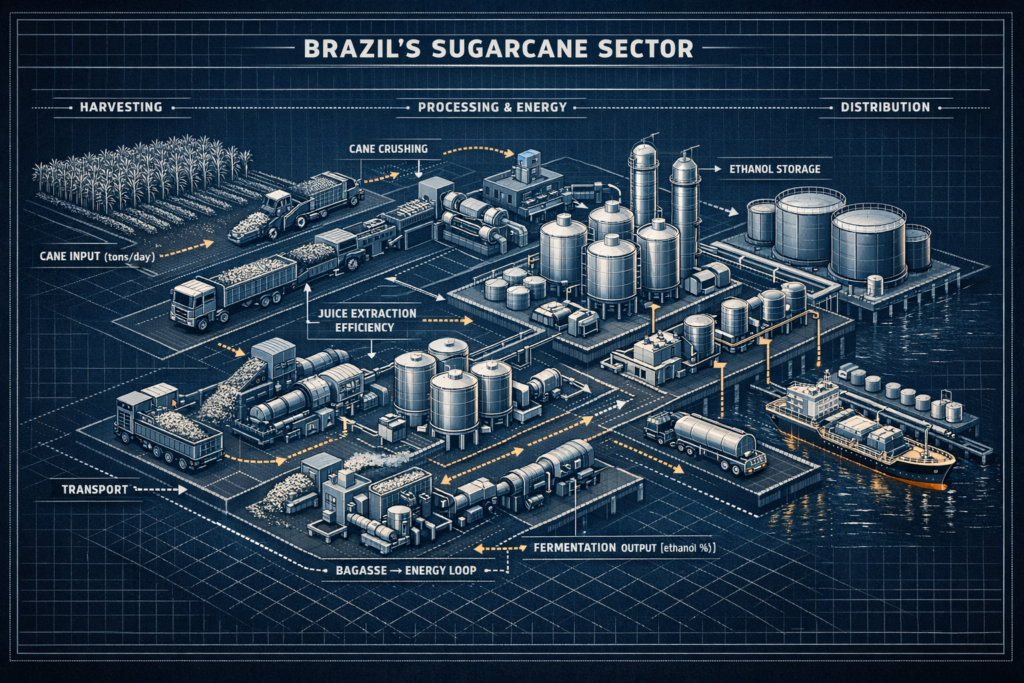
Brazil’s sugarcane sector runs at a scale that can make small equipment decisions turn into very expensive mistakes. Conab’s latest published estimate for the 2025/26 sugarcane crop was 668.8 million tons, which tells you everything about the size of the industrial footprint you’re dealing with, mills, storage, handling systems, fermentation, distillation, loading, utilities, all of it. In a sector that big, lighting isn’t a side purchase. It sits right inside safety, uptime, and maintenance strategy. (Serviços e Informações do Brasil)
And this is where a lot of facilities get tripped up. Somebody treats lighting as a catalog exercise, compares wattage, lumen output, and price, then assumes the job is done. But in a sugar mill or ethanol plant, the real question is tougher: will this fixture stay safe and reliable in a place where you may have combustible sugar dust, flammable vapors, washdowns, vibration, heat, corrosion, and maintenance teams that are already stretched thin?
That’s why the phrase explosion-proof fixtures matters so much in Brazil’s sugar and ethanol market. It isn’t just about buying a tougher light. It’s about matching the fixture to the actual hazard, the actual operating conditions, and the actual compliance burden. Get that right, and you reduce nuisance failures, relamping headaches, and the kind of risk that keeps plant managers awake. Get it wrong, and a cheap fixture can become the most expensive line item in the project.
Why the hazard doesn’t go away just because the plant is experienced
Sugar processing can look deceptively familiar. Conveyors move, mills run, transfer points load and unload, dust collectors hum along, and people get used to the environment.
That’s part of the problem. OSHA’s combustible-dust guidance is blunt on this point: combustible material in finely divided form can become explosible when suspended in air under the right conditions.
Sugar dust fits that logic. And the 2008 Imperial Sugar disaster in the United States, which killed 14 workers and injured 36, is still one of the clearest reminders of what happens when dust hazards, housekeeping, and ignition-source control get treated like background issues instead of design issues. (OSHA)
Now layer ethanol onto that picture. In ethanol plants, you’re no longer dealing mainly with dust zones around handling and transfer points. You’re also dealing with flammable liquids and vapors around production, storage, transfer, and associated process areas.
Brazil’s NR-20 explicitly applies to extraction, production, storage, transfer, handling, and manipulation of flammables and combustible liquids, and it requires risk analysis, documented maintenance, and periodic inspection for relevant installations. That changes the lighting conversation fast, because a fixture decision is no longer just electrical, it’s part of process safety management. (Serviços e Informações do Brasil)
This is also why these hazards persist. Not because managers don’t care, but because the risks are spread across ordinary operations. Dust settles on structures and cable runs. Vapors are handled as part of normal throughput.
Temporary fixes stay in place too long. A fixture that looks fine in a warehouse gets copied into a classified area because it’s “basically the same layout.” That kind of thinking is common, and honestly, it’s understandable. Plants are busy. Procurement is under pressure. Downtime costs real money. But hazardous-area lighting punishes shortcuts.
The Brazil-specific point buyers can’t ignore
In Brazil, this is not just a best-practice issue. NR-10 says materials, devices, equipment, and systems intended for electrical installations in environments with potentially explosive atmospheres must be evaluated for conformity within the Brazilian certification system.
It also states that electrical installations in classified areas or places with elevated fire or explosion risk must adopt protective devices such as alarms and automatic disconnection to prevent abnormal operating conditions. (Serviços e Informações do Brasil)
That means “explosion-proof” on a brochure is not enough. For equipment certification in Brazil, Inmetro’s framework is the reference point. Inmetro’s own guidance ties the country’s conformity requirements for electrical equipment in explosive atmospheres to Portaria Inmetro nº 115/2022, and it points buyers to ABNT NBR IEC 60079-10-1 for gas area classification, ABNT NBR IEC 60079-10-2 for combustible dust area classification, and ABNT NBR IEC 60079-14 for design, selection, and installation of electrical systems in explosive atmospheres. (Serviços e Informações do Brasil)
So the first lesson is simple. Don’t start by comparing fixtures. Start by confirming the area classification study and the certification path that applies in Brazil.
That sounds obvious, but it gets skipped more than people admit. A facility manager may be handed three proposals for sugar mill explosion-proof lighting, and all three look polished. Nice renderings. Nice LED claims. Lots of talk about efficiency. But if one supplier is vague on Inmetro certification, another is fuzzy about dust versus gas classification, and the third can’t clearly map the fixture to the actual area schedule, then you’re not comparing apples to apples. You’re comparing marketing.
What actually makes one fixture better than another in a sugar mill or ethanol plant
A strong fixture choice usually wins on six things, not one.
- First, it matches the classified area correctly. That’s the non-negotiable part. In a sugar mill, some locations may be driven by combustible dust concerns. In an ethanol plant, other areas may be driven by flammable vapor risk. Some sites have both in different process zones. A good supplier doesn’t wave at that complexity. They ask for the area classification drawings, the process description, the ambient conditions, and the mounting details before they promise anything.
- Second, it fits the way the area is cleaned and maintained. This one gets overlooked all the time. A fixture may be technically compliant and still be a pain in real operation. If syrup mist, dust buildup, washdown practices, or corrosive exposure are part of the environment, then housing integrity, sealing, lens durability, and resistance to grime matter a lot. You don’t want a light that meets the code on day one and turns into a maintenance nuisance by month eight.
- Third, it reduces maintenance burden instead of shifting it somewhere else. This is where LEDs usually make sense, but not automatically. The right LED fixture for ethanol plant lights is one that cuts relamping in hard-to-access areas, stays stable in the site’s ambient temperature range, and doesn’t need constant cleaning or re-aiming. A cheap LED that cooks its driver or traps dust where you can’t easily service it is not an upgrade. It’s just a quieter problem.
- Fourth, it gives you the right optical distribution for the job. High lumen numbers can be weirdly seductive. But a blindingly bright fixture with poor distribution can make stairs, platforms, valves, and inspection points harder to work around, not easier. In mills and process plants, visibility is task-based. Operators need to read labels, inspect leaks, move safely on access ways, and see equipment condition. That usually means you need different lighting strategies for pipe racks, process skids, tank farms, bagging or loading areas, and maintenance access zones.
- Fifth, it supports inspection and documentation. NR-20 requires documented maintenance and inspection plans for covered installations, and that changes how you should buy. A fixture with poor documentation, unclear spare-parts support, or difficult verification steps can cost more over its life than a better-supported product with a higher initial price. For NR-20 project documentation, the rule also expects key project information to exist in Portuguese, which is another small detail that becomes very important when audit time comes around. (Serviços e Informações do Brasil)
- Sixth, it has local support that actually feels local. This matters in Brazil more than many vendors like to admit. If replacement lead times are long, certification records are hard to obtain, or technical support disappears after commissioning, the site ends up carrying the risk. Facility managers know this already. The cheapest fixture is rarely the cheapest system once a plant has to wait for parts during harvest or peak production.
The fixture types that usually make sense, and the ones that usually don’t
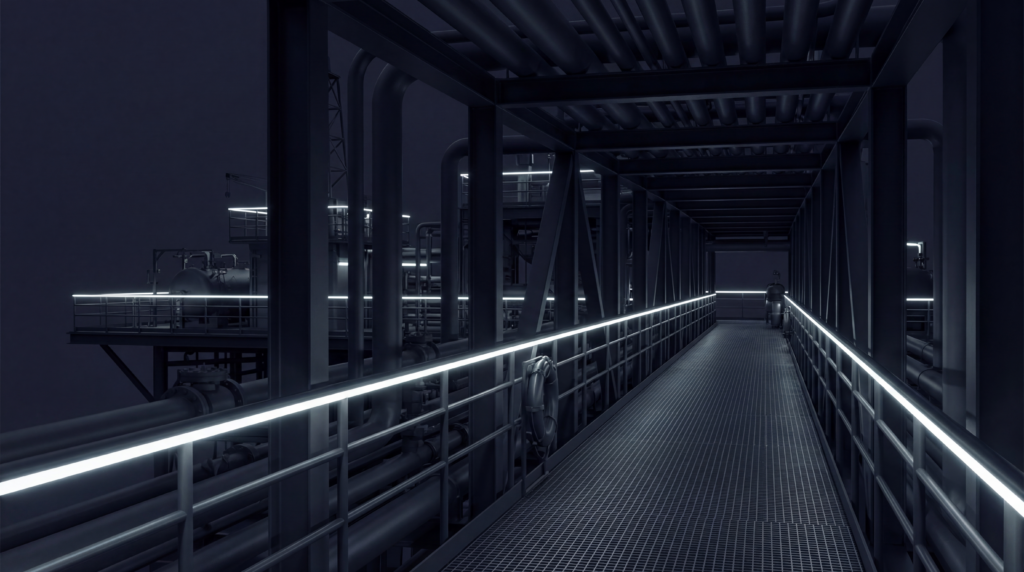
For most sugar and ethanol sites, the conversation usually lands on a few core categories: hazardous-area high bays for larger process spaces, explosion-protected flexible strip luminaires for walkways and platforms, floodlights for outdoor process and loading areas, and properly rated emergency fixtures or escape-route lighting where required by the plant design.
That mix makes sense because the site itself is mixed. You’re dealing with tall spaces, narrow access routes, outdoor exposure, utility areas, and process zones that don’t all have the same risk profile. One fixture family for the entire plant sounds efficient, but it usually leads to overspecifying safe areas and underserving difficult ones.
You end up paying too much in some places and not getting enough resilience in others. Not great.
And this is the point where flexible strip lighting should be taken off the table. For this application, it’s basically not the right tool. Sugar mills and ethanol plants need industrial, fixed, certified lighting solutions with robust housings, defensible installation methods, and a clear maintenance path.
Flexible strip products may be fine in decorative or light-duty environments, but for hazardous industrial service in Brazil’s sugar and ethanol sector, other lighting solutions are the better fit.
The smartest buyers ask tougher commercial questions
A good commercial comparison is not, “Which fixture is brightest for the money?”
It’s more like this:
- How does the supplier map each fixture to the classified area schedule?
- What Brazilian conformity evidence do they provide, and is it easy to verify?
- What does the maintenance interval look like in your actual environment, not in a clean lab?
- How does the luminaire handle dust accumulation, washdown, vibration, and heat?
- What happens when a driver fails, a gasket ages, or a lens clouds up?
- Can your team inspect it and replace it without a circus act on a scaffold?
That’s the kind of questioning that separates a serious industrial lighting package from a shiny quote deck.
There’s also a broader operational reason to be strict here. Under NR-20, employers must report certain leak, fire, or explosion events involving flammables and combustible liquids to labor inspection within two business days when serious consequences occur.
So even if lighting is only one layer of protection, it sits inside a regulatory environment that treats incidents very seriously. Buyers who treat fixture selection as part of risk reduction, not just capex control, are reading the room correctly. (Serviços e Informações do Brasil)
What the right lighting decision really buys you
The best explosion-proof fixture choice for a Brazilian sugar mill or ethanol plant is rarely the flashiest one. It’s the one that fits the classified area, survives the environment, supports maintenance, and doesn’t create a documentation headache later.
That matters because these plants don’t fail all at once. They usually drift into trouble. Dust gets missed. A seal ages. A substitute fixture gets installed during a rush repair.
A supplier’s paperwork turns out to be thin.
An operator starts working around bad visibility because the light level has quietly degraded.
Those are boring little failures, and boring little failures are often what set up the big ones.
So when you compare sugar mill explosion-proof options or shortlist ethanol plant lights in Brazil, don’t just ask what the fixture costs. Ask what kind of risk, labor, and downtime it removes from your plant over the next five years.
That’s the better buying lens. And honestly, in this industry, it’s the one that tends to hold up when production gets messy, weather gets rough, and the plant is too busy for second chances.